Bulk Book Printing Guide for Publishers
Bulk book printing means running a single large order—typically 500 copies or more—where offset presses deliver a lower cost per copy than digital printing. BookBaby’s 2026 wholesale pricing lists runs from 25 up to 25,000 books, with the sharpest price breaks hitting at 250, 500, and 1,000 units. Locking in your quantity tier first drives every downstream decision, from paper weight (60–80 lb text) to binding type, making run size the single most important choice before you upload a file.
How does offset printing differ from digital when you’re doing large runs? What actually determines your true cost per unit? Which paper, binding, and trim specifications matter the most? And how do you steer clear of the three most expensive mistakes people tend to make?
LeadWorks generally recommends locking in your quantity tier first, since that choice drives every other decision that follows downstream.
Quick Takeaways
- Offset printing beats digital costs at roughly 500–1,000 copies or more.
- Lock in your quantity tier first; it drives all decisions.
- Grab sharpest price breaks at 250, 500, and 1,000 units.
- Choose perfect binding for paperbacks, case binding for 300+ page hardcovers.
- Always request a physical proof before printing runs above 500.
What’s bulk book printing and when does it make sense for publishers?
Bulk book printing basically means running one big order at once, usually 500 copies or more, where offset presses end up cheaper per copy than digital does. Below that number, print-on-demand (which just means printing books as they get ordered) usually wins on both cost and risk. The threshold really matters because Blurb offers offset printing only for orders of 750 copies or more, and that line reflects genuine press economics, not marketing talk.
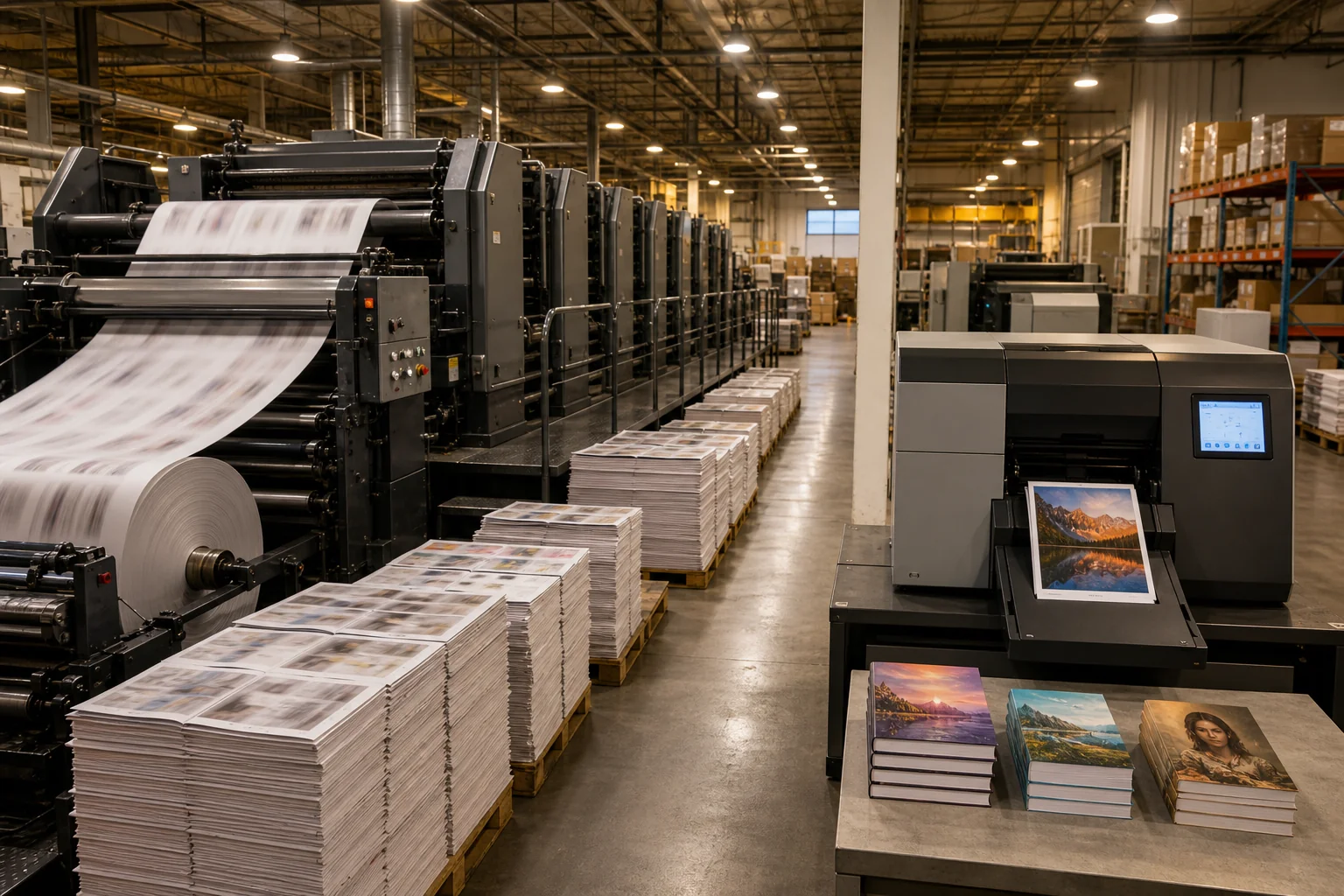
Here is the main trade-off to understand. Offset printing spreads a fixed setup cost, meaning plate making, press calibration, and ink mixing, across every single copy you print. Print 100 books and that setup cost dominates your price per unit. Print 3,000 and it nearly disappears. Digital printing skips plates completely, so it stays flat and cheap at low counts, though it never gets much cheaper as the volume goes up.
What’s the difference between bulk printing, short runs, and print-on-demand?
The three of them sit on a kind of volume ladder. Print-on-demand makes one copy when a customer places an order. Short runs cover roughly 25 to 500 copies for a controlled batch. Bulk printing starts right where offset takes over, and it scales up hard from there.
- Print-on-demand: 1 copy per order, no inventory to hold, the highest cost per copy, digital only.
- Short run: 25 to 500 copies, either digital or short-run offset, good for testing out a title.
- Bulk / offset: 500+ copies, the lowest cost per copy, though it requires warehousing and upfront cash.
Vendor minimums vary quite a bit. One wholesale service prints anywhere from 25 up to 25,000 copies with price breaks at 250, 500, and 1,000. Those break points are essentially your signal, because each one marks exactly where the math starts shifting in your favor.
Which publisher scenarios justify a bulk commitment?
Bulk really makes sense when the demand is already proven or locked in by a contract. Three cases stand out here.
Backlist reprints. A title with a steady sales history carries almost no forecasting risk at all. You already know it sells, so committing to 2,000 copies at a low price per unit beats reordering 100 at a time and paying that setup cost on every reorder.
Launch stock. A book with pre-orders, a marketing push, or some media coverage needs copies ready to go on day one. Print-on-demand lead times and pricing per copy can completely strangle a launch. Bulk gives you inventory that is ready for the shelf.
Distribution deals. A retail or wholesale contract that spells out specific quantities forces you into bulk. If a distributor commits to 3,000 units, you print 3,000, and the deal takes the guesswork right out of it.
Since all three of these cases hinge on volume, LeadWorks builds around that reality as an integrated manufacturer that handles in-house process control along with special finishes like edge printing, and those capabilities only pay off at bulk volumes, where keeping consistent color and binding across thousands of copies is the hard part. For publishers weighing a first large order, the honest rule is pretty simple. Don’t commit to bulk just to save money on copies you haven’t sold yet. Warehousing, cash tied up, and the risk of remaindering (which means dumping unsold stock at a loss) can wipe out the savings per unit.
Print bulk when you know you can sell it, not when you are only hoping to.
How much does it cost to print 1,000 copies of a book?
Printing 1,000 copies typically runs $2,500 to $9,000 total, or roughly $2.50 to $9.00 per copy, depending on format. A 250-page 6×9 black-and-white paperback usually lands near $3.00,$4.50 per unit.
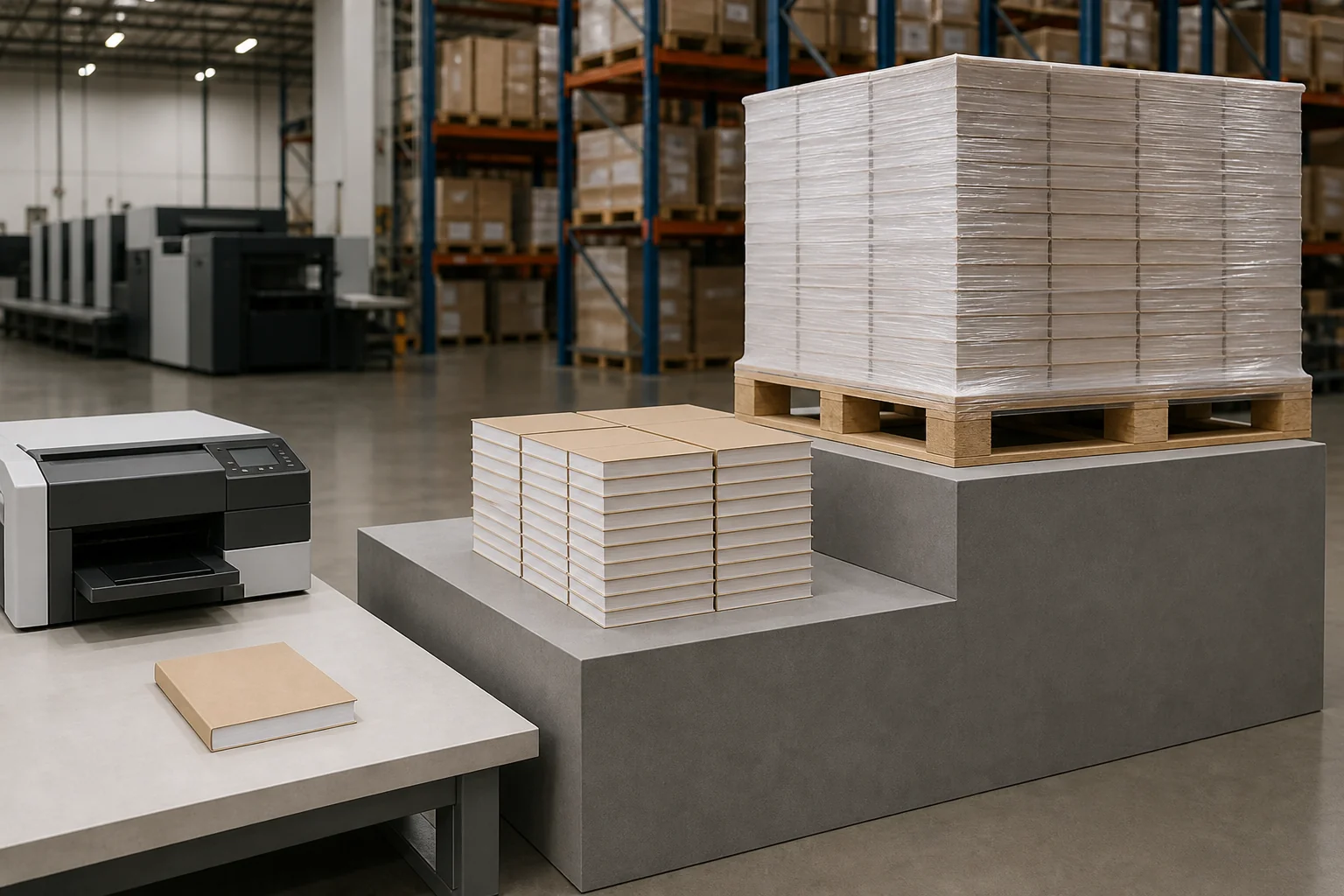
Color and hardcover push that far higher. At 1,000 copies, offset printing kicks in, and that changes the whole cost math.
Why 1,000? Because that’s the volume where offset printing becomes available, one provider offers it at 750 copies or more. Offset presses use metal plates, so they carry a fixed setup cost that shrinks per-copy as your run grows. That’s the core of bulk book printing economics.
What does a 250-page 6×9 paperback actually cost at 1,000 copies?
Here’s a worked example so you see landed cost, not a headline quote. Landed cost means the total you pay to get books on your dock, print, plates, and freight combined.
| Cost line | B&W paperback | Color paperback | Hardcover (B&W) |
|---|---|---|---|
| Per-unit print | $3.20 | $6.80 | $6.50 |
| Print subtotal (1,000) | $3,200 | $6,800 | $6,500 |
| Plate / setup | $350 | $500 | $450 |
| Freight (domestic pallet) | $400 | $450 | $650 |
| Landed total | $3,950 | $7,750 | $7,600 |
| True per-copy | $3.95 | $7.75 | $7.60 |
Notice the freight line. A 1,000-copy pallet of 250-page paperbacks weighs around 900,1,100 lbs.
Shipping it across the U.S. often adds approximately $0.40,$0.65 per book, money buyers forget until the invoice arrives.
Why are setup and plate fees the trap in bulk quotes?
Setup and plates are fixed. They don’t drop when your quantity rises, so they hurt small runs most. At 1,000 copies, a $350 plate charge adds approximately $0.35 per book. Push to 3,000 copies and that same charge falls to approximately $0.12 per book, a 66% cut on that line alone.
This is why comparing “per-copy” quotes without the full breakdown misleads publishers. LeadWorks builds quotes with plates, paper grade, binding, and freight itemized, so you can see where your money goes and negotiate the right line. Ask any vendor to split these out before you sign.
Volume breaks reward planning. One retail provider gives 25 free books for every 100 you buy, a 25% savings on units. Order 1,000 and those breaks compound. Undershoot, and you pay setup twice on a reprint.
How much does it cost to print a 500-page book?
A 500-page book costs more to print than a 200-page book of the same trim size, often approximately 40% to 70% more for each copy, because the number of pages pushes on three things at the same time. Those three things are the amount of paper used, how wide the spine ends up, and which binding method you can actually use. In a bulk book printing run of 1,000 copies, a 500-page paperback usually comes out around $4.50 to $7.00 for each unit, while the same title made as a case-bound hardcover climbs to $9.00 or higher.
Page count isn’t only a matter of “more paper.” Once you reach 500 pages, the book crosses certain limits that end up reshaping your whole spec sheet.
Why does page count change paper weight and spine width?
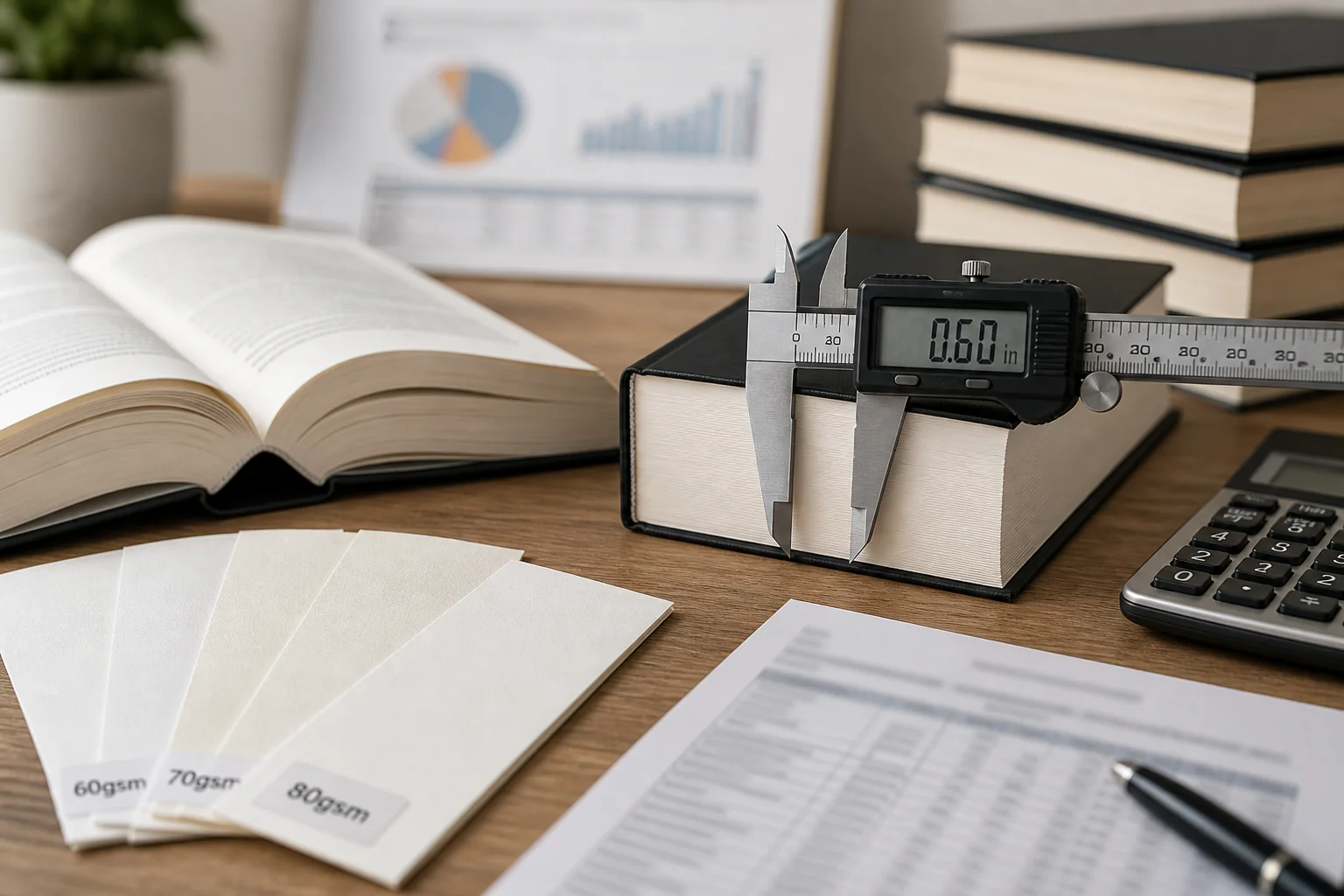
Adding more pages basically forces you toward a lighter paper. A 500-page book printed on the standard 80gsm stock would turn out thick and heavy, so printers often drop down to 60gsm or 70gsm to keep the spine a reasonable size and hold the shipping weight down. Lighter paper costs less for each sheet, though it does carry the risk of show-through, which is when text on the back of a page can be seen faintly from the front.
The spine width grows in step with the page count and the thickness of the paper, sometimes called paper caliper. Using a rough industry figure of 0.0025 inches for each sheet on offset stock, 500 pages, which is 250 sheets, produces a spine close to 0.625 inches. That measurement decides your cover design, so it really has to be locked in before printing starts.
- Paper weight: 60–70gsm keeps a 500-page block usable, while heavier stock inflates the thickness and drives up freight cost.
- Spine width: around 0.6 inches at 500 pages, and the cover artwork has to match down to the millimeter or the title prints off-center.
- Binding limit: perfect binding handles 500 pages well, though saddle-stitch, which is stapled binding, tops out near 64 to 80 pages.
How does the same 500 pages price differently across formats?
The format you choose decides more of the cost than the page count itself. Color printing costs 4 to 6 times as much for each page compared with black-and-white, and case-bound hardcover adds board, endpapers, and a separate step to assemble the cover. Industry lead-time data shows paperbacks finish in about 5 to 10 days, while hardcover production runs around 3 weeks. That gap in time reflects the extra labor that gets priced into every hardcover unit.
| Format (500 pages, 1,000 copies) | Ink | Est. per-copy cost |
|---|---|---|
| Perfect-bound paperback | B&W | $4.50–$7.00 |
| Perfect-bound paperback | Full color | $12.00–$18.00 |
| Case-bound hardcover | B&W | $9.00–$13.00 |
| Case-bound hardcover | Full color | $16.00–$24.00 |
Here is one practical tip. For a text-heavy 500-page title, ask for a black-and-white interior with color used only on inserts that are grouped together into a signature. This keeps the color plates on a single section instead of pricing the entire block at color rates. For hardcover projects, LeadWorks recommends confirming the spine width against the exact paper caliper that the plant will actually run, since a 0.6-inch spine that is misjudged by just 2mm ruins the cover alignment on every copy in the batch.
How does the bulk printing process actually work from file to pallet?
Bulk Book Printing moves through eight controlled stages: checking your files before print (called preflight), producing a digital proof, arranging the pages (imposition), making the plates, running the offset press, binding, trimming, and shipping on pallets. For a paperback order running into the several thousands of copies, you can generally expect 5 to 10 production days plus another 1 to 5 days for shipping, according to Blurb’s 2026 turnaround figures. Hardcover runs tend to stretch closer to three weeks.
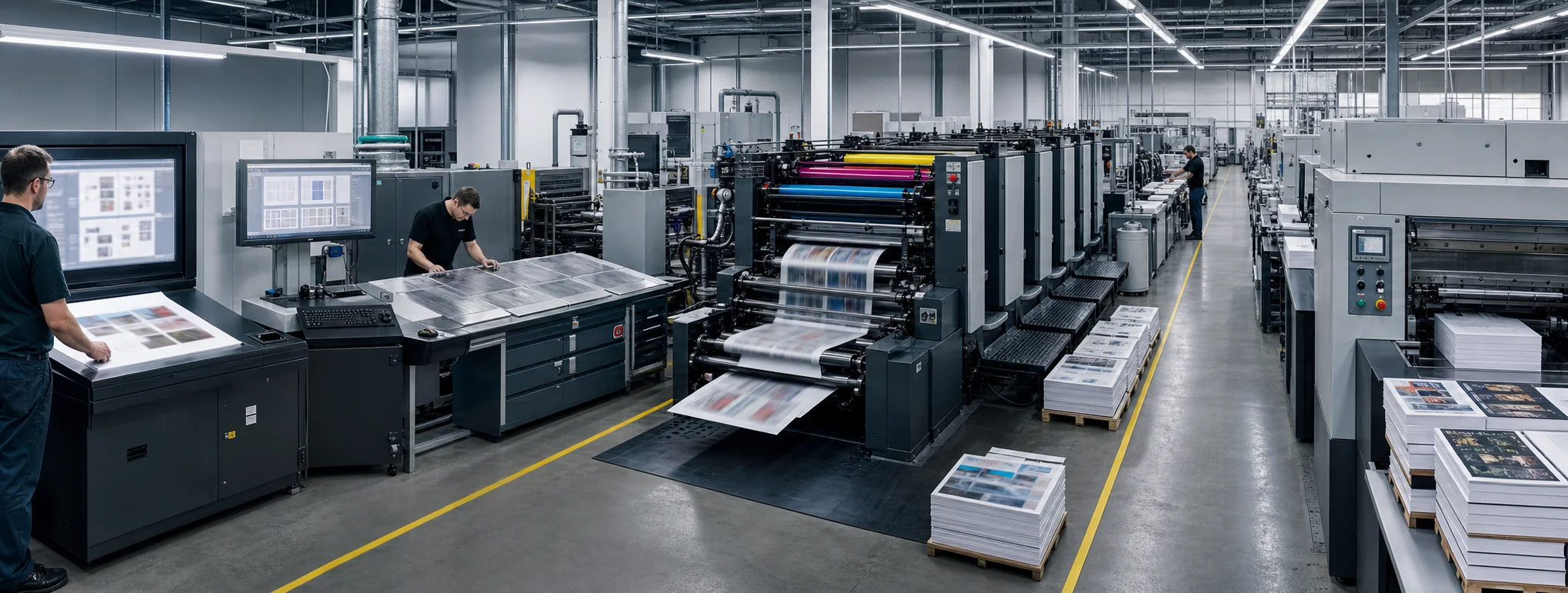
The whole chain really begins before a single sheet ever prints. Preflight software scans your PDF for low-resolution images (anything under 300 DPI), missing bleeds, and fonts that weren’t properly embedded. If you skip this step, a 5,000-copy run can reproduce a blurry cover 5,000 times over. And that is easily the most expensive mistake in the entire workflow.
What happens during proofing and plate-making?
Proofing catches the errors before any plates get burned. A digital proof, which is essentially a color-accurate printout, shows you exactly how the pages are going to look. Once you approve it, imposition arranges the pages into printer spreads, usually 16 or 32 pages per signature, so they fold together in the correct order.
Plate-making then etches each color layer onto aluminum plates for the offset press. This step is really why offset makes sense once you’re at volume: the plates cost a fixed amount upfront, and then every extra copy after that is cheap to produce. You can learn more about how offset lithography transfers ink from the plate to a rubber blanket and then onto the paper.
Where does in-house control cut errors and time?
In-house control matters the most at the handoffs. Every time a job leaves one facility to go to another, with printing happening here, binding there, and special finishes somewhere else, you add days to the schedule and take on the risk of mismatched color or stock that gets damaged while in transit.
LeadWorks runs printing, binding, and special finishes like edge printing (which is colored or gilded designs applied to the trimmed page edges) all under one roof. That approach removes two of the shipping legs entirely, and it lets a single team fix a color drift right on the press floor within hours instead of days.
- Preflight: automated PDF checks for 300 DPI, bleed, and fonts, generally done the same day
- Offset run: sheets print at 10,000+ impressions per hour on commercial presses
- Trimming: guillotine cuts to the final trim size within a 1mm tolerance
What are the most common mistakes publishers make on large orders?
The four costliest mistakes on bulk book printing runs are wrong bleed and spine specs, undersizing the run and reprinting at a higher unit price, ignoring the overrun clause, and skipping a physical proof. Each one triggers rework or margin loss. Fix them at the file and contract stage, not after the press starts.
How do wrong bleed and spine specs wreck a run?
Bleed is the extra image area that extends past the trim line so no white edge shows after cutting. Skip it and you get a thin white sliver on cover edges. The standard is 0.125 inch (3mm) of bleed on every side, per Adobe’s InDesign documentation.
Spine width is worse. It depends on page count and paper thickness (caliper). Guess it wrong on a 400-page book and your title sits crooked, wrapping onto the front cover. Decision rule: always request a spine calculation from your printer using your exact page count and paper stock, never eyeball it from a past project.
Why does undersizing the run cost more?
Publishers often print 500 to save cash, sell out, then reprint 500. That second run pays full setup again. Unit cost on a 1,000-copy order can be 30% to 45% lower per copy than two separate 500-copy runs, because plate and setup fees spread across more units.
Decision rule: if your 12-month sales forecast exceeds 70% of a higher price break, print to that break. Volume tiers stack fast, BookBaby’s wholesale pricing shows breaks at 250, 500, and 1,000 copies (2026).
What does an overrun clause actually mean?
An overrun clause lets the printer deliver and bill a few percent over or under your ordered quantity, standard trade practice on offset. Order 5,000 and you might receive 5,150 with a bill for the extra. Ignore this and your budget breaks.
Decision rule: confirm the tolerance in writing (typically ±5% to ±10%) before signing. LeadWorks tightens this range on quoted jobs so publishers budget precisely rather than absorbing surprise units.
Why never skip a physical proof?
A screen shows RGB color; a press prints CMYK. Blues shift, deep blacks flatten. A hardcopy proof, a real printed and bound sample, catches color drift and binding fit before 5,000 copies commit. Reprinting a full run over a proof-stage error routinely costs thousands. Approve the physical proof, in your hands, every time.
Frequently asked questions about bulk book printing
Bulk book printing answers below cover the four questions publishers ask most before signing a purchase order: single custom copies, how bulk differs from standard services, minimum order quantities, and lead times. Each answer is built from 2026 printer data so you can quote a number and plan a run without guessing.
Can you print a single custom copy before a bulk run?
Yes. Most digital printers accept a quantity of one, and some ordering tools take runs from 1 to 2,000 copies with page counts from 24 to 840 pages (2026). That single copy is your proof, a printed sample you hold in your hands.
Order one before committing to 1,000. A physical proof catches spine text that drifts, cover colors that shift under real ink, and gutter margins that swallow your inner text. Approving a screen PDF and skipping the proof is how publishers end up with a full pallet they can’t sell.
How is bulk book printing different from standard book printing services?
Standard services print small digital runs on demand, one book at a time. Bulk book printing runs one large batch, the whole quantity prints together, usually on offset presses, which lowers the cost per copy as volume climbs.
The crossover point is where price breaks kick in. Volume discounts can start at 10 or more copies, but true offset economics usually begin at 750 copies (2026). Below that, digital is cheaper per unit. Above it, offset wins. LeadWorks handles the offset tier with in-house process control, so color and special finishes like edge printing stay consistent across thousands of copies.
What are typical minimum order quantities for bulk printing?
Bulk minimums usually start at 100 copies and scale into the tens of thousands. Printer ranges vary widely:
| Printer type | Minimum quantity | Maximum quantity |
|---|---|---|
| Wholesale digital range | 25 copies | 25,000 copies |
| Bulk offset service | 100 copies | 100,000+ copies |
| Offset threshold | 750 copies | — |
Price breaks typically land at 250, 500, and 1,000 copies. Some printers sweeten the low end: one service gives 25 free books when you buy 100, a 25% savings (2026).
What are realistic lead times for a bulk order?
Paperback production usually takes 5 to 10 days; hardcover and board books run about three weeks (2026), per bulk printer estimates. Add 1 to 5 days for shipping on top. Build in a proof cycle and a buffer, rush a bulk run and you inherit the preflight and proof mistakes covered earlier.