Best book binding types for professional printing
The main types of book binding used in professional printing are perfect binding, saddle stitching, case binding, and mechanical bindings like spiral and wire-O. Saddle stitch works best for booklets under 64 pages and costs the least per unit, while perfect binding suits paperbacks from 60 to 400 pages. Case binding (hardcover) lasts longest, and section-sewn binding survives 10,000-plus opening cycles. Choosing among these types of book binding by page count first, then durability and budget, saves the most money.
Which method fits your page count and budget? What does each cost per unit? Which binding lasts longest? In LeadWorks’ view, picking binding by page count first, then durability, saves the most money on real print runs.
Quick Takeaways
- Saddle stitch booklets under 64 pages for the lowest per-unit cost.
- Use perfect binding for paperbacks between 60 and 400 pages.
- Choose case binding for hardcovers needing maximum shelf durability.
- Pick spiral or wire-O for manuals that must lay flat.
- Select section-sewn binding for books facing 10,000-plus opening cycles.
What are the main types of book binding used in professional printing?
Professional printing really comes down to four main binding families: perfect binding, saddle stitching, case binding, and mechanical bindings like spiral and wire-o. Saddle stitching uses wire staples pushed through folded pages, and it is one of the most cost-effective methods when you have a low page count. Case binding, though, is the standard for tough hardcovers that need to last. The trick is matching the type to your page count, your budget, and how long the book needs to survive on a shelf.
The thing that matters most for buyers is the difference between big trade printing and short-run work. Perfect binding and case binding run efficiently once you hit 500 copies or more, so publishers reach for them when making novels, catalogs, and coffee-table books. Spiral and wire-o make more sense below 250 copies, since they need less setup and no waiting around for glue to dry.
Here is the practical breakdown, going family by family:
- Perfect binding: Pages get glued to a wrapped softcover spine. This works best for paperbacks, magazines, and brochures running over 40 pages. The PUR glue versions, which stands for polyurethane reactive, resist cracking better than the older EVA hot-melt adhesives did.
- Saddle stitching: Folded sheets stapled right through the spine fold. This is ideal under 64 pages, because thicker stacks start to bulge and simply won’t lie flat.
- Case binding: A sewn or glued text block wrapped inside a rigid board cover. It is the most common hardcover method, and it is built to survive for years.
- Mechanical (spiral/wire-o): Punched holes threaded with a metal or plastic coil. It opens a full 360 degrees, so it suits cookbooks, manuals, and workbooks nicely.
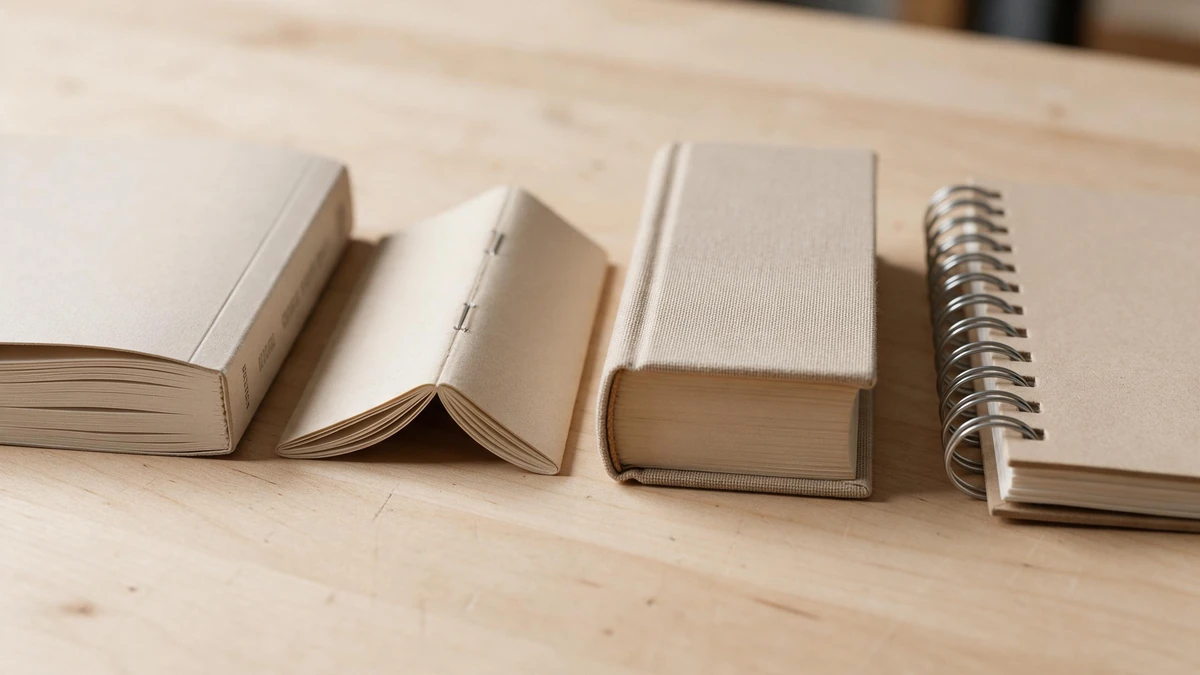
The four main binding families: perfect, saddle, case, and mechanical
A common mistake buyers make is picking saddle stitching to save money, then finding out that a 90-page report simply won’t staple cleanly. Page count actually decides more than the budget ever does.
Among these types of book binding, the glue quality is really what separates cheap work from durable work. PUR adhesive holds up through temperature swings from freezing all the way to roughly 200°F, which matters a lot for books shipped overseas. LeadWorks does PUR perfect binding and sewn case binding in-house, along with special finishes such as edge printing right on the text block. Having that process controlled in-house keeps the spine alignment consistent across large trade runs.
You can think of these types of book binding as tiers, essentially. Mechanical bindings favor function above all. Saddle stitching favors speed and a low price. Perfect and case binding favor that polished retail look people expect. The next sections compare each pairing head-to-head, so you can figure out and spec the right one.
Perfect binding vs saddle stitching — which is better for paperbacks and brochures?
For paperbacks and thicker catalogs, perfect binding wins; for brochures and thin booklets under 64 pages, saddle stitching is cheaper and faster. The split comes down to page count. Saddle stitch caps around 64,80 pages before the spine bulges and pages fan out, while perfect binding handles roughly 40 to 800 pages. Pick by thickness first, then cost.
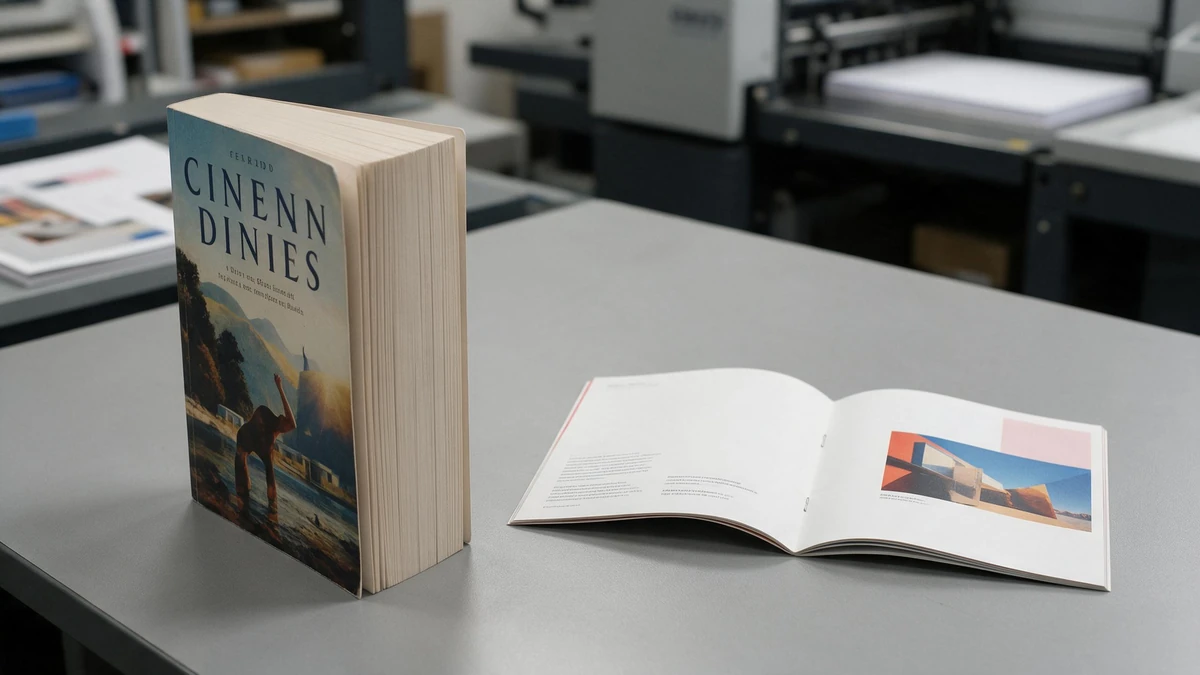
Perfect binding (left) versus saddle stitching (right)
Saddle stitching folds sheets and drives wire staples through the spine fold. It’s one of the simplest, lowest-cost methods in the printing industry. Because staples sit at the center, the whole book must divide evenly by four pages. Go past 80 pages and you hit “creep”, inner pages push outward and get trimmed unevenly.
Perfect binding glues loose page edges to a wrapped cover, creating a flat, printable spine. That spine is the real advantage. You can print a title and author on it, so the book stands upright on a shelf and reads like a real paperback. Saddle-stitched booklets have no spine to print at all.
When does PUR beat standard EVA glue?
PUR (polyurethane reactive) adhesive beats standard EVA (ethylene-vinyl acetate) whenever durability or lay-flat matters. PUR bonds are roughly twice as strong as EVA and survive heat and cold that crack EVA spines. For coated art paper, common in photo-heavy brochures, EVA often fails to grip, while PUR locks it down.
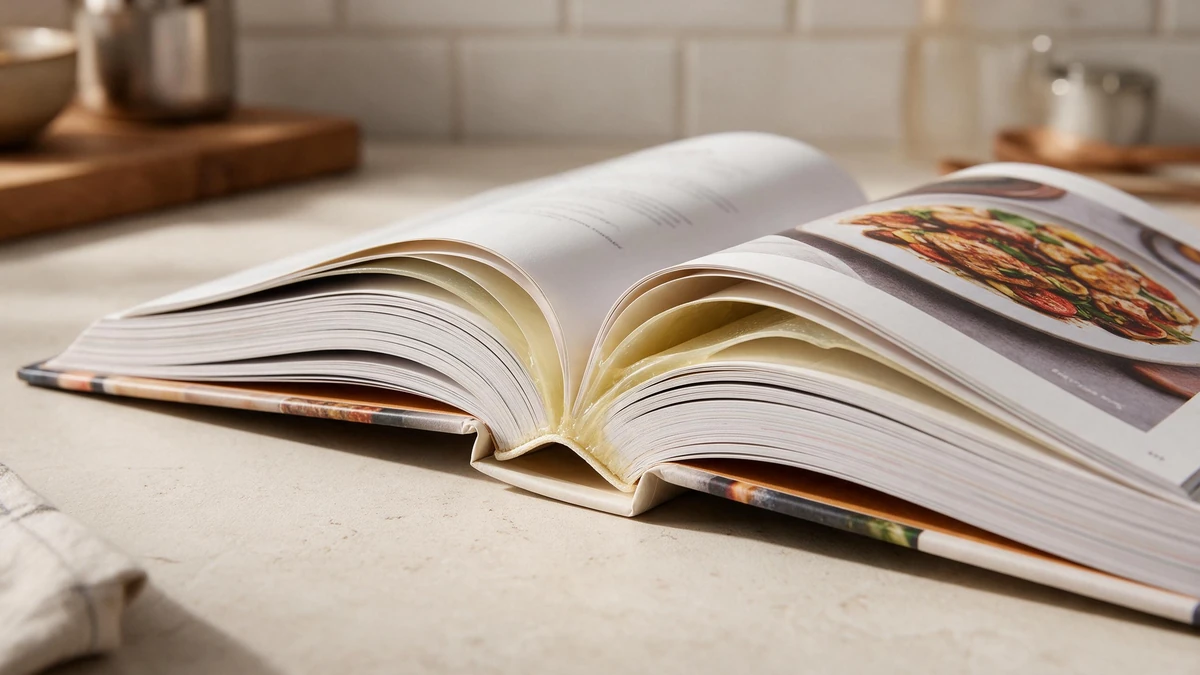
PUR adhesive keeps a perfect-bound spine flexible and durable
EVA still makes sense for cheap, short-life jobs like promotional catalogs. It sets in seconds and costs less. But PUR is the standard for books meant to last years or open near-flat, such as cookbooks and manuals. LeadWorks recommends PUR for any coated-stock title above 200 pages, where EVA page-pull failures spike.
Which one costs less per unit?
Saddle stitching costs less per copy at low page counts because it skips glue, drying, and spine milling. Among the common types of book bnding, it needs the fewest production steps. Perfect binding adds tooling but scales better on long runs and thick jobs, its per-unit cost drops sharply above 500 copies.
| Factor | Saddle stitching | Perfect binding |
|---|---|---|
| Page range | 8–80 pages | 40–800 pages |
| Printable spine | No | Yes |
| Best adhesive | None (wire) | PUR for durability |
| Lay-flat | Good (thin) | PUR only |
| Low-run cost | Lower | Higher |
What are the hardcover options — case binding, sewn, and flexi binding?
Hardcover binding comes in three main forms, which are case binding, hardcover sewn binding, and flexi binding. Case binding is the most common type of hardcover book construction, and it works by wrapping a text block inside rigid boards. The thread-sewn versions can last more than 100 years, which is exactly why people reach for them when they need something that survives in an archive.
The core difference among these hardcover types of book binding is really about how the pages, which together are called the text block, get held in place before the cover goes on.
How does case binding work — sewn vs glued blocks?
Case binding attaches a text block to a stiff outer case that is made from thick greyboard, usually somewhere between 2mm and 3mm, and that board is covered in cloth, paper, or leather. The block itself can be held together in one of two ways, either thread sewn or glue only.
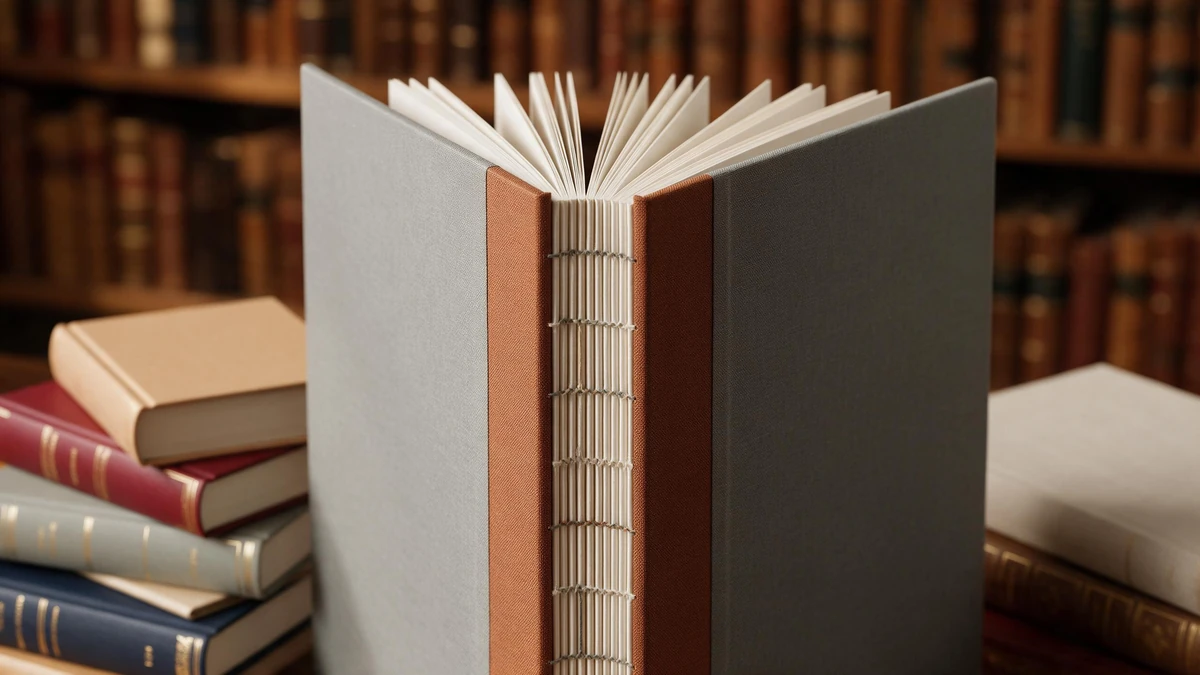
Thread-sewn case binding is the gold standard for durability
Thread-sewn case binding stitches folded signatures, which are simply groups of pages, together and then glues that sewn block into the case. This is basically the gold standard when it comes to how long the book will hold up.
Glued (adhesive) case binding skips the sewing step completely and depends on PUR glue along the spine. It costs less and moves through production faster, though the pages can loosen over decades of heavy use.
Why does thread-sewn binding outlast glue-bound books?
Thread-sewn binding outlasts glue because the stitches lock each signature to the next one, so there is no single spot where the whole thing can fail. Glue on its own breaks down when it is exposed to heat, humidity, and being opened again and again. Libraries and museums ask for sewn binding on anything that needs to survive for a century.
Sewn perfect binding is essentially a hybrid, where the signatures are sewn first and then the spine is milled and glued the way a paperback would be. You end up with most of the strength of full sewing at a lower price. Plenty of premium photo books and reference titles use this method.
What’s flexi binding and when should you pick it?
Flexi binding uses a semi-rigid cover that is thinner than a full hardcover case but stiffer than a paperback. Picture a heavy card cover that bends a little when you handle it. It pairs a sewn or PUR block with a flexible board, which gives a premium feel while keeping the weight and the cost lower.
| Option | Block method | Archival life | Typical turnaround |
|---|---|---|---|
| Case binding (sewn) | Thread sewn | 100+ years | 15–25 working days |
| Case binding (glued) | PUR glue | 20–40 years | 10–15 working days |
| Sewn perfect binding | Sewn + milled glue | 50+ years | 12–18 working days |
| Flexi binding | Sewn or PUR | 30–50 years | 10–14 working days |
LeadWorks recommends thread-sewn case binding for publishers who are producing hardcover editions that are meant to last, and flexi binding for brands that want a premium look without the weight or the cost of a full board. Because the process is controlled in-house, LeadWorks can match the spine glue and the sewing to the weight of the paper, and that really cuts down on pages pulling out of titles that get handled a lot.
How do lay-flat and hand-sewn bindings compare for photo books and premium projects?
When it comes to photo books and art editions, lay-flat binding tends to win on image continuity, while hand-sewn binding wins on durability and that handcrafted feel. Lay-flat construction gets rid of almost all gutter loss, which is the part of the image area that gets swallowed up by the spine, and this lets a photo stretch across two pages with no break in the middle. Hand-sewn methods look and feel genuinely handmade, though they still lose some spread width. Your choice really comes down to whether spreads or long-term archival life matters more to you.
Why does lay-flat binding beat standard case binding for full-spread photos?
Lay-flat binding opens a full 180 degrees and stays flat with no springback, so a landscape photo crossing the center gutter stays whole and unbroken. Standard case binding, which is the most common hardcover method, pulls the inner margin into a curved valley and ends up hiding 8,15mm of image on each page. For wedding albums and portfolios, that swallowed strip completely ruins panoramic shots.
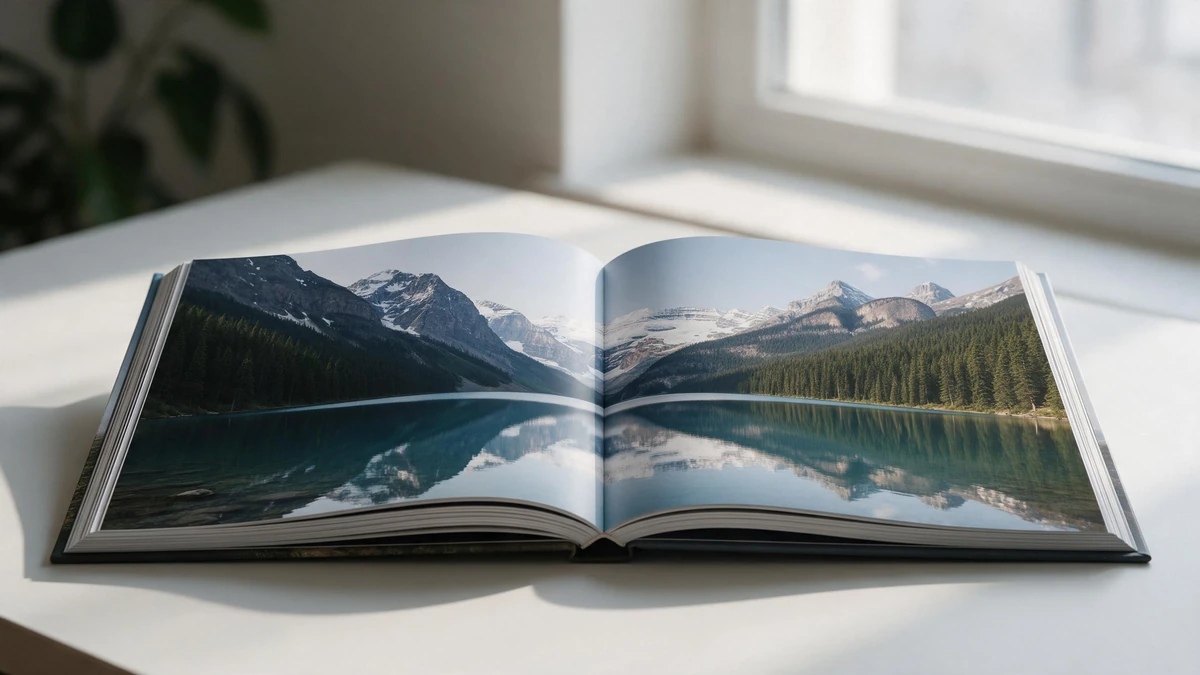
Lay-flat binding keeps a full panoramic spread unbroken
There are two lay-flat types that dominate the market. Layflat photobook construction prints on thick single sheets bonded back-to-back, which gives you stiff, flat spreads. And PUR-based lay-flat uses a flexible glue that bends without cracking, so the pages keep sitting open on a table.
What do Japanese stab and hand-sewn bindings offer that machines can’t?
Japanese stab binding, which stitches through punched holes near the spine edge, along with hand-sewn book binding, delivers visible craft and museum-grade longevity. Section-sewn spines survive decades of opening and closing, and a good hand-sewn signature block outlasts glued spines that fail once the PUR adhesive softens over time. The trade-off, though, is a gutter you simply can’t flatten, since stab binding sacrifices 20,30mm of usable spread.
| Method | Gutter loss | Image continuity | Cost vs case binding |
|---|---|---|---|
| Lay-flat photobook | Near zero | Full spread | +40% to +80% |
| Hand-sewn (section) | 10–15mm | Slight center dip | +60% to +120% |
| Japanese stab | 20–30mm | Poor for spreads | +50% to +100% |
So when do these higher prices actually pay off among the various Types Of Book Bnding? You can generally skip them for text-only editions where there are no images to protect. Pick lay-flat for photography monographs and fashion lookbooks, where a broken spread pretty much kills the sale. And choose hand-sewn or stab binding for limited art runs under 500 copies, where buyers are paying for that tactile, physical quality. LeadWorks recommends pairing lay-flat panels with edge printing on premium art editions, since keeping the special-process control in-house helps keep color-critical spreads consistent across the full run.
How much does each binding type cost and what are the minimum order quantities?
Saddle stitch is the cheapest binding at every run size, starting under $1.50 per copy at 100 units, while case binding stays the priciest at approximately $6,$12 per copy even at 2,000 units. Glue-based methods like perfect binding drop the fastest as volume climbs, so your ideal choice among the types of book binding shifts with print quantity.
What does each binding type cost at 100, 500, and 2,000 copies?
The table below shows typical per-unit price, minimum order quantity (MOQ), and turnaround for common binding methods. Figures reflect 2026 offset and digital pricing for a standard 6×9-inch, 200-page book.
| Binding type | 100 copies | 500 copies | 2,000 copies | MOQ | Turnaround |
|---|---|---|---|---|---|
| Saddle stitch | $1.40 | $0.85 | $0.55 | 50 | 3–5 days |
| Perfect (EVA glue) | $3.10 | $1.90 | $1.15 | 100 | 5–8 days |
| PUR glue | $3.80 | $2.30 | $1.45 | 250 | 7–10 days |
| Case bound | $11.50 | $8.00 | $6.20 | 250 | 15–25 days |
| Spiral / coil | $2.20 | $2.00 | $1.90 | 25 | 3–6 days |
Why do glue-bound books get cheaper at volume while spiral stays flat?
The split comes down to setup versus per-page labor. Glue binding uses a hot-melt or PUR machine that costs the same to warm up whether you run 100 books or 2,000. Spread that fixed cost across more copies, and the per-unit price falls sharply, perfect binding drops approximately 63% from 100 to 2,000 copies in the table above.
Spiral and coil binding barely move. Each book gets punched and threaded separately, so labor scales one-to-one with quantity. There is no big machine setup to amortize. That’s why mechanical bindings stay near $1.90,approximately $2.20 across every run, a cost pattern most competitor guides skip entirely.
One practical tip: PUR glue costs more than EVA per copy but resists cracking in cold shipping and heavy page counts. For a 400-page cookbook or a title shipping to cold climates, LeadWorks recommends PUR despite the 25% premium, because return rates from split spines cost far more than the upcharge.
Frequently asked questions about book binding types
Short answer to the most common questions: the strongest stitch is section-sewn, the cheapest run under 100 copies is saddle stitch, and page count decides more than budget. These four answers cover the queries buyers ask most before ordering.
What are the main binding stitch types?
Two stitch families dominate professional work: wire stitching and thread sewing. Saddle stitch uses wire staples driven through folded pages at the spine fold, which makes it fast and cheap but limited to lighter jobs. Thread-based methods split further.
- Section-sewn (Smyth sewn): folded signatures sewn together with thread along the spine for maximum durability. Section sewing handles heavy use over decades.
- Singer sewn: a single running stitch through the whole book, tough enough that it’s used for passports.
- Saddle stitch: wire staples through the fold — best under 64 pages.
What book binding materials should I ask about?
Material choice affects both cost and lifespan. For covers, request the board weight (2mm greyboard is standard for case binding) and the cover stock in gsm. For adhesive spines, ask for PUR glue instead of hot-melt EVA, PUR flexes without cracking and survives temperature swings that make cheaper glue fail. LeadWorks specifies PUR by default for lay-flat and photo work, since edge-printing and premium finishes lose value if the spine splits within a year.
How do I choose binding by page count?
Page count is the first filter, ahead of price. Use this quick map:
| Page count | Best binding | Why |
|---|---|---|
| 4–64 | Saddle stitch | Staples can’t hold thicker spines flat |
| 60–800 | Perfect / PUR | Flat spine takes glue cleanly |
| 40–1,000+ | Section-sewn case | Sewn signatures scale to large books |
What’s the cheapest binding for short runs?
Saddle stitch is the cheapest for short runs, often starting under $1 per copy at 100 units because it skips gluing and drying steps. Among the types of book binding suited to runs below 250 copies, spiral and wire-o come next, since they need no minimum tooling. Case binding rarely pays off below 300 copies. For 25,50 sample copies, LeadWorks recommends saddle stitch or PUR digital, keeping unit cost low while you test the market.