Custom Cookbook Printing: The Complete Guide to Binding, Paper, and Production
Quick Takeaways
- Custom cookbook printing combines binding method selection, paper choice, and print technology to produce functional, durable cookbooks.
- Hardcover cookbook printing delivers premium durability for heirloom-quality and retail cookbooks.
- Spiral bound recipe book printing and Wire-O cookbook printing provide lay-flat functionality essential for hands-on kitchen use.
- Softcover cookbook printing offers an economical entry point without sacrificing professional appearance.
- Full color cookbook printing ensures food photography is reproduced with the accuracy audiences expect.
- Offset cookbook printing is preferred for medium to large production runs, offering superior color consistency.
- Wholesale cookbook printing provides scalable solutions with competitive unit pricing for publishers ordering in volume.
Why Custom Cookbook Printing Matters
Every cookbook represents more than a collection of recipes — it is a curated experience blending practical instruction with visual storytelling. Whether preserving generations-old recipes, launching a chef’s debut publication, or producing a branded culinary piece, custom cookbook printing determines how that experience reaches the reader.
Off-the-shelf printing solutions rarely accommodate cookbook-specific demands: food-safe durability, lay-flat usability, accurate color reproduction for food photography, and binding that survives repeated kitchen use. Custom cookbook printing addresses each need through deliberate material and structural choices made before production begins.
For publishers and brands, custom cookbook printing also provides control over production economics. Decisions about binding type, paper weight, print run size, and finishing directly affect unit cost, retail positioning, and shelf appeal. Understanding the full production landscape — from professional book printing services to material specifications — is essential before committing to a manufacturing partner.
Cookbook Binding Options: Choosing the Right Structure
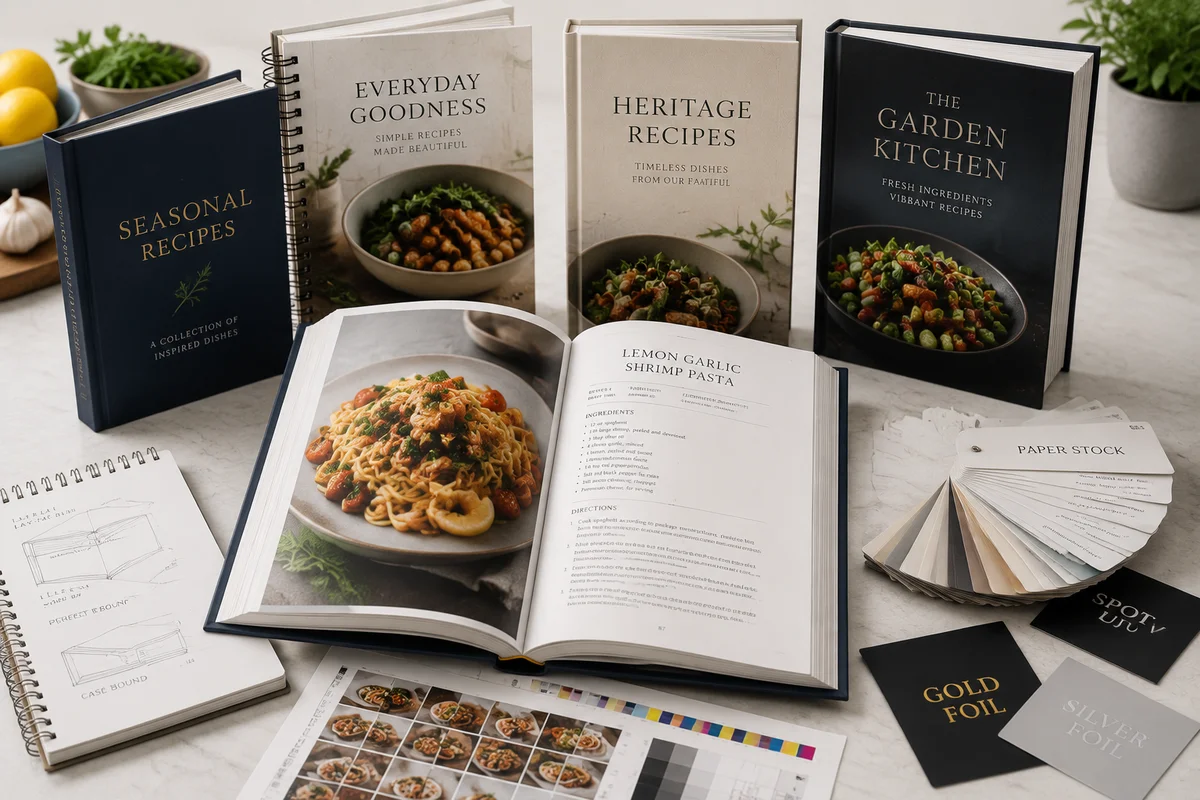
Binding is the single most consequential decision in custom cookbook printing. It determines how the book opens, how long it lasts, and how it performs under real kitchen conditions. The following table compares the most common binding types used in custom cookbook printing:
| Binding Type | Lay-Flat | Durability | Best For | Page Count Range | Relative Cost |
| Hardcover (Case Bound) | Partial | Excellent | Premium retail, heirloom, chef cookbooks | 60–800+ | Higher |
| Softcover (Perfect Bound) | Limited | Good | Trade paperbacks, fundraising, budget editions | 40–400 | Lower |
| Wire-O Binding | Full 360° | Very Good | Kitchen-use, instructional, professional kitchens | 20–300 | Medium |
| Spiral Binding | Full 360° | Good | Community cookbooks, casual use, workbooks | 20–300 | Lower-Medium |
| Saddle Stitching | Limited | Fair | Booklets, promotional, short recipe collections | 8–64 | Lowest |
Hardcover Cookbook Printing — Premium and Durable
Hardcover cookbook printing is the gold standard for cookbooks intended for retail distribution, gifting, and long-term preservation. Also known as case binding, this method attaches printed pages to a rigid board cover wrapped in cloth, printed paper, or leather-like material. According to Wikipedia’s entry on bookbinding, case binding emerged in the 19th century as the dominant hardcover method and remains preferred for publications requiring archival durability.
For cookbook applications, hardcover cookbook printing provides superior physical protection — the rigid cover shields interior pages from bending, spills, and wear. Smyth-sewn signatures, where pages are physically stitched in folded groups, further enhance longevity by preventing pages from loosening over repeated use. This makes hardcover cookbook printing the preferred choice for family recipe book printing projects where the final product is intended to become an heirloom.
Hardcover cookbooks also command higher retail pricing, making them commercially attractive for chef cookbook publishing. The spine provides generous real estate for title display, an advantage for bookstore visibility. Finishing options such as foil stamping, embossing, and premium finishing techniques can further differentiate a hardcover cookbook in a competitive market.
Softcover Cookbook Printing — Practical and Economical
Softcover cookbook printing, also referred to as perfect bound cookbook printing, uses a flexible cardstock cover glued to the spine of the book block. This method is widely used in trade publishing and is a practical option for mass-market distribution, fundraising campaigns, and community projects where budget is a primary consideration.
While softcover cookbook printing does not match hardcover durability, modern PUR adhesives have significantly improved binding strength and flexibility. This makes softcover viable for cookbooks up to approximately 400 pages. For custom recipe journal printing and workbook-style cookbooks, softcover provides an affordable structure that still presents professionally.
One limitation of softcover cookbook printing is lay-flat performance — perfect bound books naturally resist staying open, particularly in early and late sections. For cookbooks serving as active kitchen references, this should be weighed against cost savings.
Wire-O Cookbook Printing and Spiral Bound Recipe Book Printing — Lay-Flat for Kitchen Use
For cooks who need both hands free while referencing a recipe, lay flat cookbook printing is not a luxury — it is a functional requirement. Wire-O cookbook printing and spiral bound recipe book printing deliver full 360-degree page rotation and true lay-flat performance on any kitchen counter — the two most practical binding choices for active cooking environments.
Wire-O cookbook printing uses double-loop metal wires threaded through punched holes along the binding edge. The result is a clean, professional appearance with smooth page turning and full lay-flat capability. Wire colors — black, white, silver, and custom options — allow design coordination with the cookbook’s visual identity. This binding is particularly well-suited for professional culinary book printing, cooking school manuals, and restaurant training materials where durability under heavy use is critical.
Spiral bound recipe book printing uses a continuous plastic or metal coil. While visually more casual than Wire-O, spiral binding offers excellent flexibility — pages can be folded completely back, reducing the footprint on a crowded countertop. Spiral binding is popular for family recipe book printing, community fundraiser cookbooks, and cooking workbooks. Both binding methods excel at functional lay flat cookbook printing, keeping pages securely open without manual holding.
Both bindings can be combined with clear acetate covers and durable cardstock backing for added spill resistance. For publishers exploring these options, Wire-O and spiral binding solutions offer full customization including trim sizes, wire colors, and cover materials.
Paper Selection for Custom Cookbook Printing
Paper is the physical foundation of every custom cookbook printing project. The paper stock chosen for interior pages and covers directly affects how food photography appears, how the book feels in hand, and how well it withstands kitchen conditions. In any custom cookbook printing specification, paper selection requires balancing three priorities: visual quality, durability, and production budget.
Coated vs. Uncoated Paper in Cookbook Production
The choice between coated and uncoated paper is the starting point for paper specification in custom cookbook printing.
Coated paper (gloss or matte finish) is the preferred choice for cookbooks featuring full color cookbook printing with extensive food photography. The coating seals the paper surface, preventing ink from absorbing into the fibers and producing sharper, more vibrant image reproduction. Coated stock can reproduce a wider color gamut and finer detail than uncoated alternatives, making it essential for food photography book printing where color accuracy is non-negotiable. Gloss coated paper maximizes contrast and saturation, while matte coated paper reduces glare under bright kitchen lighting.
Uncoated paper offers a natural, tactile experience preferred for text-heavy cookbooks and custom recipe journal printing projects. Uncoated stock has a warmer feel and is easier to write on — practical for interactive cookbooks where users may want to add notes. Uncoated paper also costs less than coated alternatives but produces noticeably duller color reproduction — food photography will appear softer and less saturated than the same images on coated stock.
Paper Weight Guide for Cookbook Printing
| Paper Weight (GSM) | Thickness Feel | Best Application | Color Performance | Durability Note |
| 80–100 gsm | Light, slightly translucent | Text-heavy cookbooks, novels | Acceptable for text, poor for photos | Prone to show-through on double-sided printing |
| 115–128 gsm | Standard, moderate opacity | General cookbooks with mixed content | Good for coated stock | Adequate for moderate use |
| 150–157 gsm | Substantial, good opacity | Image-heavy cookbooks, food photography | Excellent on coated stock | Resists curling from humidity |
| 200 gsm | Heavy, premium feel | Premium chef cookbooks, coffee table books | Magazine-quality on coated matte | Excellent durability |
| 250–350 gsm | Card-like rigidity | Covers, dividers, tab pages | N/A (cover application) | Maximum structural strength |
Production insight: heavier paper improves perceived quality and resists kitchen humidity better, but it also increases binding diameter for Wire-O and spiral projects — a thicker book block requires a larger coil or wire size, affecting overall handling.
Full Color Cookbook Printing: Making Food Photography Shine
Food photography is arguably the most critical visual element in any cookbook. Readers make snap judgments about recipe quality based on how food appears on the page. Full color cookbook printing must deliver accurate, appetite-appealing color reproduction — and this is where print technology and color management converge.
CMYK Color Management and Image Preparation
Professional custom cookbook printing operates in the CMYK color space, not the RGB space used by digital cameras and screens. Images prepared in RGB and converted late in the process often exhibit color shifts — reds become muddy, greens lose vibrancy, and food appears unappetizing. Setting up files in CMYK from the start, using a standardized color profile such as FOGRA39 or GRACoL, maintains color accuracy throughout production.
Image resolution is equally important. Food photography book printing requires source images at a minimum of 300 DPI at the intended print size. Lower-resolution images appear soft or pixelated in print even if they look acceptable on screen.
Color proofing is an essential quality checkpoint. A calibrated hard-copy proof on the same paper stock as the final run allows verification of color accuracy before mass production begins — particularly important for chef cookbook publishing where brand colors and food styling must match the intended visual standard.
Offset vs. Digital Cookbook Printing: Which Method to Choose
The choice between offset and digital printing is one of the most impactful production decisions in custom cookbook printing. Each method has distinct advantages depending on print run size, quality requirements, and budget constraints. The following comparison outlines how each approach affects the economics and output quality of a custom cookbook printing project.
| Factor | Offset Cookbook Printing | Digital Cookbook Printing |
| Print Run Sweet Spot | 500+ copies | 1–500 copies |
| Unit Cost (per copy) | Decreases with volume | Relatively flat |
| Color Consistency | Excellent across long runs | Good, minor variation possible |
| Setup Cost | Higher (plates, makeready) | Lower (no plates required) |
| Paper Options | Extensive | Limited to digital-compatible stocks |
| Turnaround Time | 2–5 weeks | 3–7 days |
| Custom Ink (Pantone) | Yes | Typically not available |
| Variable Data | Not standard | Supported |
Offset Cookbook Printing for Volume Production
Offset cookbook printing uses aluminum printing plates to transfer ink to paper via a rubber blanket cylinder. The initial setup — plate creation, ink calibration, and makeready — requires more investment than digital printing, but once running, offset presses produce exceptionally consistent color at high speeds with lower per-unit costs as quantity increases.
For wholesale cookbook printing orders and large-scale publishing projects, offset is the clear choice. Economies of scale become meaningful above approximately 500 copies, with unit costs continuing to decline as quantity rises. Offset presses also accommodate a wider range of paper stocks and can print with custom Pantone spot colors — important for professional culinary book printing where precise brand color matching is required. According to Smithers, a print industry research firm, offset lithography remains the dominant print technology for book manufacturing globally.
Digital Printing for Short-Run and On-Demand Production
Digital printing eliminates plates entirely — the image is transferred directly from a digital file to the print substrate using toner or inkjet technology. This makes digital printing ideal for short-run custom cookbook printing, test markets, and projects requiring rapid turnaround. Digital presses also support variable data printing, enabling personalized copies — a growing trend in family recipe book printing where individual copies can include custom dedications.
Production insight: many professional book printers run both offset and digital equipment, allowing them to recommend the optimal technology based on project specifications. When evaluating custom cookbook printing manufacturers, confirming in-house offset capability signals the ability to scale production efficiently.
Cookbook Finishing Options for a Professional Look
Finishing techniques transform a printed book block into a polished, market-ready product. In custom cookbook printing, finishing serves both protective and aesthetic functions — guarding against kitchen hazards while elevating perceived value.
Cover Finishes
Lamination (gloss or matte) is the most common protective finish for cookbook covers. Gloss lamination enhances color saturation and provides a wipe-clean surface. Matte lamination offers a sophisticated, glare-free look with a soft tactile finish. Soft-touch lamination creates a velvety surface texture that adds a premium sensory dimension.
Spot UV applies a high-gloss coating to selected cover areas, creating contrast between glossy and matte surfaces — effective for highlighting the cookbook title or a central food image.
Foil stamping uses heat and pressure to apply metallic foil — gold, silver, copper, or colored — to the cover. It conveys premium quality and is commonly used on chef cookbook publishing projects to elevate perceived value.
Edge Finishing
Edge printing applies color or design to the trimmed edges of a book block — a technically demanding process that creates a dramatic visual effect. Edge printing is one of the most distinctive finishing techniques available in premium custom cookbook printing, often used for collector’s editions and high-end culinary publications.
Gilded edges — applying metallic foil to the page edges — delivers a classic, luxurious aesthetic available in gold, silver, and other metallic finishes.
Additional Structural Elements
Die-cut tabs divide cookbook sections for quick reference. Ribbon markers provide a built-in bookmark. Endpapers present an opportunity for branding or pattern design.
For publishers exploring these options, premium book finishing and structural solutions combine multiple techniques within a single production workflow. Custom cookbook printing that incorporates strategic finishing choices — from foil-stamped covers to edge-printed book blocks — commands higher perceived value and stronger retail positioning.
The Cookbook Printing Production Process
Understanding the manufacturing workflow behind custom cookbook printing helps publishers plan realistic timelines and communicate effectively with production partners.
Pre-Production
Pre-production begins with file verification — artwork files are checked for resolution (minimum 300 DPI), color mode (CMYK), bleed (minimum 3 mm), font embedding, and safe margin compliance. Material specification follows: paper stock, binding type, cover material, and finishing techniques are confirmed against the project brief. A pre-production proof is produced using the specified materials for client approval.
Printing
Once the proof is approved, full-scale printing begins. For offset cookbook printing, plates are created and the press is calibrated to match the approved proof. Color bars enable real-time density monitoring throughout the run. For digital printing, the print-ready file proceeds directly to press.
Production insight: color can drift slightly during long offset runs. Professional printers run periodic pull samples at regular intervals to maintain consistency from the first copy to the last — a critical quality practice in professional culinary book printing and any project where color fidelity is non-negotiable.
Binding and Finishing
Printed sheets move to the bindery for folding, collating, and binding. For hardcover cookbook printing, the book block is cased into the cover. For Wire-O cookbook printing, pages are punched and wire elements inserted. Custom cookbook printing relies on this integrated post-press workflow to maintain structural integrity across all binding types. Finishing processes — lamination, foil stamping, spot UV, edge printing — are applied according to specification.
Quality Control and Shipping
Each finished book undergoes inspection against quality standards: binding integrity, trim accuracy, color fidelity, and finishing precision. A pre-delivery sample is reviewed before the full shipment is released. According to ISO 9001 quality management standards, multi-stage inspection — inline during production, post-production sampling, and pre-shipment review — forms the foundation of consistent manufacturing quality. Once approved, cookbooks are packaged and dispatched, with the entire process typically spanning 3 to 5 weeks from file approval to delivery.
Wholesale Cookbook Printing: Scaling Production Efficiently
For publishers, brands, and organizations that produce cookbooks at volume, wholesale cookbook printing offers the most cost-effective path to market. Wholesale pricing structures are built on economies of scale: larger quantities spread fixed costs (plate creation, press setup, bindery configuration) across more units, reducing per-copy cost significantly.
Wholesale cookbook printing is not limited to offset production. Digital wholesale programs exist for titles that sell consistently but in modest quantities, using print-on-demand or small-batch replenishment models that minimize inventory holding costs. The key to wholesale efficiency is working with a manufacturer that offers both offset and digital capability.
For chef cookbook publishing and professional culinary book printing at commercial scale, working directly with a manufacturer removes markup layers and provides direct access to production expertise. When evaluating wholesale partners, confirm in-house production capability, inquire about material sourcing, and review the comprehensive book printing guide that covers material, binding, and production planning for successful custom cookbook printing projects.
Family Recipe Book Printing: Preserving Culinary Heritage
Family recipe book printing occupies a special place in custom cookbook printing. Unlike commercial cookbooks, family cookbooks prioritize personal significance and culinary heritage — digitizing handwritten recipes, scanning vintage photographs, and organizing contributions into a cohesive volume.
The binding choice often gravitates toward spiral bound or Wire-O for active kitchen use, while hardcover is preferred for heirloom gifts with Smyth-sewn archival durability. Most family projects benefit from digital printing’s low minimums and fast turnaround. Full color cookbook printing adds irreplaceable emotional value — seeing grandmother’s handwriting in vivid color alongside family photographs.
Common Cookbook Printing Mistakes to Avoid
Even experienced publishers encounter pitfalls in custom cookbook printing. Identifying these issues early prevents costly reprints.
Choosing binding based solely on cost. The binding is the functional backbone of a cookbook. Opting for perfect binding to save money may produce a book that refuses to stay open during use — undermining the cookbook’s primary purpose. Select binding based on use case, not budget alone.
Neglecting paper and binding compatibility. Paper weight directly affects spine thickness. A 300-page cookbook on 200 gsm stock will have a substantially thicker spine than the same book on 128 gsm paper, potentially exceeding the maximum diameter of a planned Wire-O or spiral binding. Paper and binding must be specified together, not independently.
Using RGB images for print. Converting RGB food photographs to CMYK at the printer almost always produces color shifts. Convert all images to CMYK using the printer’s preferred color profile before file submission for the most reliable results.
Skipping the physical proof. A digital PDF cannot replicate how ink looks on paper, how a binding performs, or how a cover finish feels. A physical proof on production stock is the only reliable verification before committing to a full print run.
Underestimating production lead time. Rush production limits paper options, reduces finishing choices, and increases the probability of quality issues. Adequate lead time preserves flexibility.
Overlooking packaging. A beautifully printed cookbook that arrives damaged represents wasted investment. Confirm packaging specifications — individual shrink-wrap, corner protectors, carton strength — as part of the production agreement. For publishers ready to begin a custom cookbook printing project, contact our team to discuss specifications and receive a tailored production timeline.
Frequently Asked Questions
What is the best binding for a cookbook used in the kitchen?
Wire-O cookbook printing and spiral bound recipe book printing are the best options for active kitchen use because they allow the book to lay completely flat — or fold back 360 degrees — without requiring hands to hold pages open. Wire-O offers a polished, professional look while spiral binding provides casual flexibility. For cookbooks that balance kitchen use with display, hardcover cookbook printing with Smyth-sewn binding delivers strong durability with partial lay-flat capability.
How many recipes should a printed cookbook contain?
There is no fixed minimum or maximum. Professional chef cookbooks typically contain 100 to 300 recipes. Family recipe book printing projects may include anywhere from 20 to 150 recipes. Beginner cookbooks often succeed with 30 to 50 curated recipes. The ideal count depends on purpose and audience — quality and organization matter more than volume.
How long does custom cookbook printing take?
Standard production timelines for custom cookbook printing range from 3 to 5 weeks from file approval to delivery, depending on quantity, binding complexity, and finishing requirements. Digital short-run custom cookbook printing can be completed in 5 to 10 business days.
What paper is best for food photography in cookbooks?
Coated paper in the 150–157 gsm range — either gloss or matte — provides the best reproduction of food photography. Gloss coated maximizes color saturation, while matte coated reduces glare under kitchen lighting. For premium food photography book printing, 200 gsm coated matte paper delivers a magazine-quality feel with minimal show-through.
Can I print a cookbook using only my family’s handwritten recipes?
Yes. Handwritten recipes can be scanned at high resolution (300 DPI minimum) and incorporated into the cookbook layout alongside typeset versions. Many family recipe book printing projects juxtapose original handwritten cards with transcribed recipes, preserving personal touch within a single printed volume.
Is offset cookbook printing always better than digital?
Not always. Offset cookbook printing is superior for print runs above approximately 500 copies due to lower per-unit costs and excellent color consistency. Digital printing is better for short runs, fast turnaround, and variable-data personalization. The optimal custom cookbook printing method depends on quantity, timeline, and whether custom Pantone colors are required.