Eco-Friendly Hardcover Book Printing Explained
A hardcover eco-friendly book printing option that you’ll commonly find offered in 2026 is casebound production, which works well for nonfiction, prestige titles, novels, and collector’s editions, according to the green print offerings available right now. Essentially, you end up with a durable, premium book without the environmental cost that usually comes along with it, and you get there by swapping virgin paper for recycled or FSC-certified stock, petroleum inks for soy or vegetable inks, and glossy laminates for compostable coatings. LeadWorks generally recommends that you judge any “green” hardcover claim by three things, the paper source, the ink chemistry, and the binding adhesive, rather than trusting marketing language on its own.
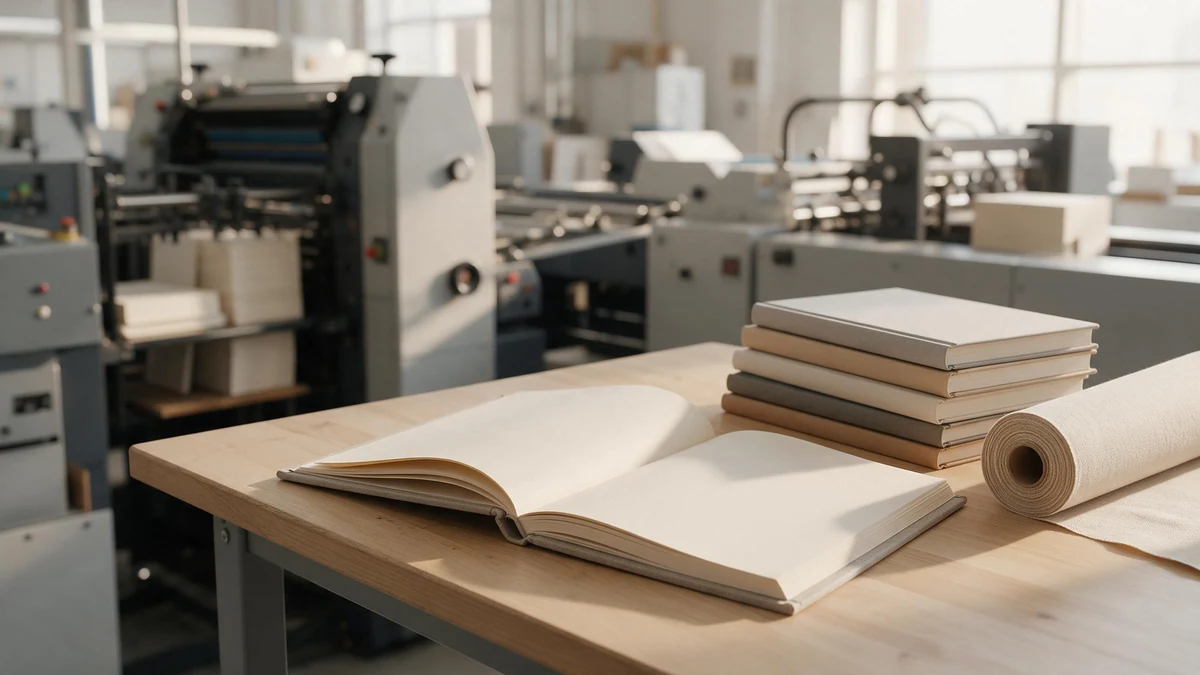
Eco-friendly casebound hardcover production with recycled board and cloth
This guide is meant to answer the questions that buyers actually ask about the Eco Friendly Hardcover Book Printing Options available to them. What is it that makes a hardcover book genuinely “eco-friendly” as opposed to greenwashed? Which paper and ink options are out there, and how do they really compare when it comes to cost and durability? What binding methods let you avoid toxic glues? How much more does green printing cost per unit? And which certifications actually back up the claim being made?
Quick Takeaways
- Choose recycled or FSC-certified stock to cut nearly 50% of impact.
- Swap petroleum inks for soy or vegetable options to improve recyclability.
- Specify PUR adhesive binding to avoid toxic hot-melt glues.
- Verify every layer: paper, ink, board, cloth, adhesive, and finishing.
- Reject greenwashing by demanding certifications over vague marketing claims.
What Makes Hardcover Book Printing Eco-Friendly?
Eco-friendly hardcover book printing means every physical layer gets picked to cut down on environmental harm, not just the inside pages. That covers the paper, the ink, the binder’s board, the cover cloth, the adhesive, and the finishing. Paper on its own drives close to 50% of a book’s total environmental impact (2026), so a recycled text block matters most of all. Still, it’s really only one piece of a six-part system.
A hardcover carries more weight than a paperback in every sense of the word. It stacks up extra materials, a rigid board core, a wrapping fabric or printed paper, glued endpapers, and often a foil or laminate finish. Each layer adds carbon, and some layers, like plastic laminate film, can make the whole book impossible to recycle if they get handled the wrong way.
Where do the biggest environmental gains actually hide?
The gains hide in the parts that buyers tend to ignore, meaning the board and the adhesive. Binder’s board is basically a dense chipboard, and a single case can weigh 150 to 300 grams before the block even goes inside. Swapping virgin board for grey board with a high recycled content cuts that footprint right at the heaviest point. The adhesive matters too, since PUR, which stands for polyurethane reactive glue, bonds cleaner and lets the pages come apart for recycling better than the older hot-melt kind did.
Here is the part that goes against what you’d expect. People obsess over “recycled pages” while the cover cloth, dyed with heavy synthetic pigments, and the shiny lamination quietly do more damage.
How does a hardcover’s footprint compare to a paperback’s?
A casebound hardcover uses more raw mass, so its footprint per unit runs higher than a stapled or perfect-bound paperback would. But hardcovers last for decades. That durability spreads the impact out over a much longer life, which is a reason casebound production stays a core eco-friendly book printing option (2026) for collector’s editions and prestige nonfiction meant to be kept rather than tossed away.
Genuinely eco friendly hardcover book printing options combine three things you can actually verify:
- Certified fiber: FSC or PEFC paper and board, with a certificate number you can check for yourself.
- Low-impact chemistry: soy or vegetable inks plus water-based coatings, sometimes called aqueous, instead of solvent film.
- Recoverable construction: adhesives and finishes that let the book be recycled once it reaches the end of its life.
LeadWorks handles this by controlling each process step in-house, including board lamination, cover finishing, and edge printing, so the material choices behind a green claim can actually be traced instead of just being promised on a spec sheet.
Which Paper Choices Matter — FSC, PEFC, and Recycled Stock Compared?
FSC-certified virgin stock, PEFC stock, and post-consumer recycled (PCR) paper each trade off differently, and approximately 100% recycled isn’t automatically the greenest pick. Since paper accounts for almost 50% of a book’s environmental impact (2026), the sheet you choose matters more than any other single decision. For most hardcovers, FSC uncoated text with 10,approximately 30% PCR content hits the best balance of footprint and print quality.
What do FSC and PEFC actually certify?
FSC and PEFC both certify that wood fiber comes from responsibly managed forests,not that the paper is recycled. FSC (Forest Stewardship Council) is the stricter of the two on Indigenous rights and old-growth protection. PEFC (Programme for the Endorsement of Forest Certification) is broader and often cheaper because it recognizes many national schemes.
Watch the label wording. “FSC approximately 100%” means all virgin fiber is certified. “FSC Recycled” means the sheet is post-consumer. “FSC Mix” blends certified, recycled, and controlled sources. A LeadWorks selection tip: always request the mill’s PCW percentage in writing and verify the FSC certificate number in the public database,a label on a spec sheet isn’t proof.
Why isn’t 100% recycled always the greenest choice?
Recycled fiber must be de-inked, which uses chemicals, water, and energy. When a book’s PCR paper travels long distances to a mill and back, transport emissions can cancel the savings. Locally sourced FSC virgin stock sometimes beats imported approximately 100% recycled once you count the full chain.
| Paper type | Typical PCR fiber | Brightness (GE) | Best use |
|---|---|---|---|
| FSC uncoated, 10–30% PCR | 10–30% | 82–88 | Text-heavy hardcover interiors |
| FSC/PEFC virgin uncoated | 0% | 90–96 | Photo-forward pages |
| 100% PCR recycled | 100% | 72–80 | Budget or high-transparency claims |
The brightness gap is the real tradeoff. A 100% recycled sheet at 74 GE reads slightly gray, which flattens photographs and fine grayscale. For eco friendly hardcover book printing options where images carry the book, a 20% PCR FSC sheet at 85 GE keeps contrast while still cutting virgin fiber. Match the paper to the content, not to the highest recycled number on the spec.

FSC-certified and recycled uncoated text paper swatches
Are Soy-Based and Low-VOC Inks Actually Better?
Yes, though the effect is smaller than most buyers assume. Soy and vegetable inks lower volatile organic compound (VOC) emissions, which are the fumes that pollute the air while ink dries, by a wide margin compared with petroleum inks, and they separate from paper more cleanly during recycling. A 2026 sustainable printing guide lists soy-based inks and water-based coatings as standard eco choices. Even so, ink is only a thin layer on the page, and the coating placed on top of it drives most of your book’s environmental footprint.
How do soy, vegetable, UV, and petroleum inks compare?
Each ink type balances VOC output, how easily it can be recycled, and how wide a color range it offers in a different way. Soy comes out ahead on emissions and on separating from paper during recycling. UV ink dries almost instantly with nearly no VOCs, but it makes recycling much harder. Petroleum ink still delivers the widest, most saturated color, which matters for photo-heavy collector’s editions.
| Ink type | VOC level | De-inking (recyclability) | Color range |
|---|---|---|---|
| Soy-based | Low | Easy, clean | Good |
| Vegetable (linseed/canola) | Low | Easy | Good |
| UV-curable | Very low | Poor, hard to strip | Wide |
| Conventional petroleum | High | Moderate | Widest |
Does soy ink still contain petroleum?
Yes, and this surprises many publishers. The name “soy ink” refers to the carrier oil, which is the liquid that carries the color, and not to the whole recipe. The colored pigments themselves are often still petroleum-based synthetics, and the ink might hold as little as 20% soy by volume. So soy improves the drying and recycling stage, though it does not make the ink fully plant-based. It helps to ask any printer for the exact soy percentage before you assume the ink is “green.”
Why do coatings matter more than ink choice?
Coatings decide whether the entire cover can be recycled at all. A glossy plastic laminate seals up the paper fiber and blocks recovery, while a water-based coating lets the paper go back into the pulp stream normally. Since paper accounts for almost 50% of a book’s environmental impact according to a 2026 analysis, protecting that paper’s ability to be recycled matters more than switching the ink.
LeadWorks pairs soy or vegetable inks with water-based coatings on standard hardcover runs, and it holds petroleum ink back for high-fidelity image plates only, where getting the color exactly right is non-negotiable. Among genuine eco friendly hardcover book printing options, that combination of ink plus coating protects both air quality and end-of-life recycling, which are the two measures that actually make a real difference.
What Eco Alternatives Exist for the Hardcover Parts People Forget — Board, Cloth, and Endpapers?
The greenest hardcover makes three quiet substitutions: recycled greyboard for the stiff core of the cover, organic cotton or recycled-PET cloth for the covering material, and uncoated recycled endpapers. These components hardly ever show up in a buyer’s brief, and yet paper and board account for close to 50% of a book’s environmental impact (2026). If you skip over them, your “green” argument really stays dirty at its core.
⚠️ Common mistake: Trusting a “green” hardcover label based on the recycled paper alone. This happens because buyers check the most visible layer and ignore the ink chemistry and binding adhesive—where petroleum inks and toxic hot-melt glues hide. The fix: verify all three signals—FSC-certified or recycled stock, soy/vegetable inks, and PUR adhesive—demanding certifications instead of accepting vague marketing claims.
Why does virgin chipboard quietly dominate the footprint?
Binder’s board, which is the rigid grey panel sitting under the cloth, is generally thick, somewhere between 2 to 3 mm, and it carries some weight. That mass is exactly where the carbon hides. Standard chipboard tends to use virgin wood pulp or a mix of unverified fiber. What you want to ask for instead is recycled greyboard made from 100% post-consumer waste. Specialist mills produce this, and it performs the same way for resisting warp at the same caliper, which is measured in microns.
Here is a practical tip that a lot of publishers miss. You should request the board’s grammage and its recycled percentage in writing, the same way you would verify FSC certificate numbers (2026). Board suppliers will often ship “recycled” stock with no documented post-consumer waste figure attached to it.
Cotton or recycled-PET cloth — which cover material is greener?
Neither one is perfect, honestly. Synthetic buckram, which is a woven cloth stiffened with a plastic or acrylic filler, is durable but it comes from petroleum and is hard to recycle. There are two lower-impact options worth considering:
- Organic cotton cloth: a renewable fiber that is biodegradable, though it takes a lot of water to grow. This works best for prestige and collector’s editions where the longevity justifies the input.
- Recycled-PET cover cloth: woven from post-consumer plastic bottles, which cuts down the demand for virgin polyester. It holds up tougher against scuffing than cotton does, so it suits library and children’s titles.
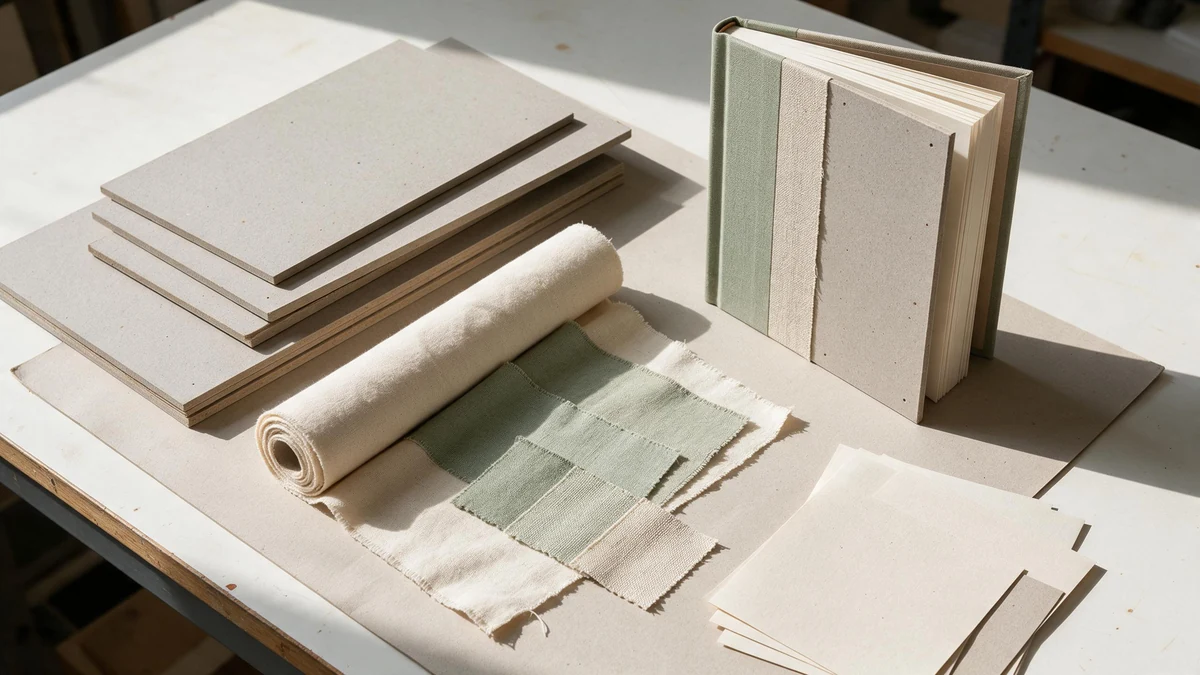
Recycled greyboard, cotton cover cloth and uncoated endpapers
For endpapers, which are the sheets glued between the cover and the text block, you should choose uncoated recycled stock rather than glossy coated paper. Uncoated sheets take PUR and starch adhesives better and they stay recyclable. LeadWorks builds these material choices into casebound quotes right from the start, since controlling the board and cloth in-house is really where most of the footprint gets decided. And when you are weighing Eco Friendly Hardcover Book Printing Options, that upfront control is what actually moves the numbers.
PUR vs. Animal Glue vs. Vegan Adhesives — Which Binding Is Greenest?
The greenest binding is Smyth sewn with a small amount of PUR (polyurethane reactive) hotmelt,not the compostable plant glue. A 2026 sustainability guide names PUR perfect binding and Smyth sewn binding as the more sustainable methods because they last decades. A book that survives 40 years beats a compostable one that fails in five and hits the landfill.
Durability is the hidden green metric most buyers miss. Binding is a tiny slice of a book’s material weight, so switching glue barely moves the carbon math. What moves it’s lifespan. A hardcover that stays readable and repairable keeps paper,the part that drives almost half a book’s footprint,out of the waste stream longer.
How do the four adhesives compare on recyclability and welfare?
PUR wins on strength, EVA on cost, sewn threads need almost no glue, and only animal-hide glue raises welfare flags. Here is the honest trade-off:
| Adhesive | Recyclability | Durability | Animal-welfare concern |
|---|---|---|---|
| PUR hotmelt | Repulpable; low glue volume | Highest; resists heat and cold | None (synthetic) |
| EVA hotmelt | Harder to repulp; softens in heat | Moderate; pages loosen faster | None (synthetic) |
| Animal-hide glue | Fully biodegradable | High; used in archival binding | Yes; made from animal byproducts |
| Plant-based vegan glue | Compostable in theory | Lowest; humidity-sensitive | None |
Why does PUR beat a compostable glue that fails early?
A compostable adhesive only helps the planet if the book actually reaches a compost facility,and almost no reader tosses a hardcover into industrial compost. PUR (a reactive glue that cures with moisture) uses about half the glue volume of EVA per spine and repulps cleanly at recycling mills. That combination of low material use plus long life is why it outperforms a fragile “green” glue.
For hardcovers, LeadWorks recommends Smyth sewn binding first,folded signatures stitched with thread, needing only a thin adhesive bead. When a sewn book’s spine wears, a bindery can re-glue it. A collapsed vegan-glue spine usually can’t be fixed.

Smyth sewn signatures stitched with thread and PUR reactive adhesive
If you want vegan certification, ask your printer to confirm the adhesive contains no animal-derived hide or bone gelatin. Most modern PUR and EVA glues already qualify,verify it in writing rather than assuming.
How Do Plastic-Free Coatings and Foil Finishes Change the Footprint?
Standard plastic lamination is the single biggest recyclability killer in hardcover book printing. A polypropylene or nylon film bonded to the cover can’t be separated at the paper mill, so the whole cover often gets pulled from the recycling stream. Since paper accounts for almost 50% of a book’s environmental impact, ruining that paper’s second life matters a lot.
Swap the film, and the footprint shifts fast. Among eco friendly hardcover book printing options, the coating choice decides whether your cover ends up as new paper or as landfill.
Which coating recycles — bio-laminate, aqueous, or none?
Aqueous coating and no-coating win. Aqueous coating is a water-based sealant that dries as a thin clear layer. It repulps cleanly, so mills accept it. Bio-laminate (a film made from wood pulp or corn-based PLA) is compostable in industrial facilities but still confuses standard paper recycling, because sorters can’t tell it from plastic film.
| Coating | Base material | Repulpable? | Best use |
|---|---|---|---|
| Aqueous coating | Water-based | Yes | Matte protection, fast turnaround |
| Bio-laminate (PLA/cellulose) | Corn or wood pulp | No (compost only) | High-gloss look without petroleum film |
| No coating | None | Yes | Uncoated recycled stock, natural texture |
| Standard plastic lamination | PP or nylon film | No | Avoid for green claims |
Do eco foil and spot-UV really contaminate recycling?
Yes, metallic foil and spot-UV both break the repulping process. Traditional hot-stamp foil uses a thin aluminum layer that won’t dissolve in the pulp slurry, and spot-UV is a plastic resin cured hard by ultraviolet light. Both leave flecks that downgrade recycled paper quality.
- Cold foil: Applied with a UV adhesive at press speed; uses less energy than hot stamping but still adds a metal layer that resists repulping.
- Eco foil / bio-foil: Metalized coating on a carrier that reduces plastic waste per sheet, yet the transferred metallic layer still contaminates the pulp stream.
- Blind deboss or letterpress: Zero added material — the design is pressed into the board. Fully recyclable and a genuine premium look.
LeadWorks steers publishers toward debossing or small foil areas over full-cover metallic wraps. The trick: keep foil under a small share of cover area so the sorter still reads the cover as paper. For collector’s editions that demand shine, pair a spot foil logo with an aqueous-coated recycled cover instead of a full plastic laminate.

Aqueous coating and blind deboss instead of plastic lamination
How Can I Verify a Printer’s Green Claims and Spot Greenwashing?
Verify a printer’s green claims by checking the actual FSC or PEFC certificate number in the public database and requesting the paper mill’s post-consumer waste percentage in writing. A 2026 sustainability workflow recommends exactly this two-step check,confirm the FSC certificate number and get PCW figures documented. If a printer can’t give you both in an email, treat the eco label as marketing, not proof.
How do I read a chain-of-custody claim correctly?
A real chain-of-custody claim carries a certificate code, not just a logo. FSC codes follow the format FSC-C###### (six digits). Enter that code at the free FSC public certificate search and confirm the company name matches your quote. PEFC and Green-e work the same way,each has a searchable registry.
Watch for scope tricks. A printer can hold valid FSC certification but still run your specific job on uncertified stock. Ask which claim type applies: “FSC Mix,” “FSC Recycled,” or “FSC 100%.” Only a printed on-product label tied to your job number proves your book qualifies.
What are the red flags of greenwashing?
Vague words with no number behind them. Reject any of these on their own:
- “Eco-friendly paper”: meaningless without a PCW percentage and a mill name.
- “Sustainable inks”: ask for the soy or vegetable oil content and the VOC rating.
- “Recyclable cover”: useless if the book carries plastic film lamination, which blocks fiber recycling.
- Self-invented logos: green leaf badges that link to no registry are decoration.
What exact questions should I ask a printer?
These three questions expose the parts vendors rarely volunteer. LeadWorks handles board sourcing, adhesive, and coating in-house, so a specific written answer,not a brochure line,is a fair test of any supplier’s process control.
- Board: Is the greyboard recycled, and what percentage? What’s the FSC scope?
- Adhesive: Is the spine PUR reactive glue, animal glue, or a vegan hot-melt?
- Coating: Is the finish an aqueous coating or plastic BOPP lamination?
Among genuine eco friendly hardcover book printing options, only suppliers who answer all three with numbers deserve your trust.
What Do Eco Hardcover Options Really Cost — Price, Minimums, and Durability?
Most eco upgrades add 5,15% to a hardcover unit price, not the 40% buyers fear. The biggest jump comes from FSC-certified uncoated paper with 10,30% post-consumer waste, which a 2026 sustainable printing guide recommends for text-heavy books. Swap coatings and adhesives cheaply; the paper and board are where money and impact actually meet.
How much do eco paper, board, adhesive, and coating swaps really add?
Paper drives cost because it drives impact,one 2026 eco-publishing analysis found paper accounts for almost 50% of a book’s footprint. Spend your budget there. The table below shows realistic per-unit ranges for a 200-page casebound title at a 1,000-copy run.
| Component | Standard cost/unit | Eco swap cost/unit | Typical MOQ | Lifespan note |
|---|---|---|---|---|
| Text paper | $1.20 | $1.45 (FSC + 30% PCW) | 500 | Equal; PCW ages like virgin stock |
| Board | $0.60 | $0.66 (recycled greyboard) | 1,000 | Equal rigidity at same caliper |
| Adhesive (PUR) | $0.15 | $0.15 (PUR is already low-VOC) | none | PUR outlasts EVA by years |
| Coating | $0.25 (film lam) | $0.18(aqueous) | none | Aqueous scuffs faster; matte hides it |
Notice the coating row. Aqueous coating is cheaper and greener than plastic film lamination,one of the rare wins with no trade-off. That single swap can offset most of the paper premium on a mid-size run.
Which eco upgrades waste money, and which pay off?
Skip vegetable-based ink premiums on jackets that also get plastic lamination. You pay more for the ink but keep the recyclability killer, so the eco claim collapses. LeadWorks steers clients toward the opposite pairing: standard soy ink plus aqueous coating, which costs less and stays fully recyclable.
Best impact per dollar goes to recycled greyboard and PUR binding. Both add pennies, both last as long or longer than conventional parts, and PUR resists page pull-out for the life of a shelf book. Eco friendly hardcover book printing options only backfire when a costly upgrade sits next to a non-recyclable finish.
Low minimums matter for small publishers,many eco printers now accept runs under 250 copies, though board MOQs often start at 1,000. Ask for the exact break points before you commit.
Frequently Asked Questions
Short, direct answers to the questions buyers ask most before ordering eco friendly hardcover book printing options. Each answer gives a specific number or spec you can act on,no filler.
What’s the most eco-friendly printing method?
Print-on-demand is the most eco-friendly method because it prints only the copies actually ordered, cutting overproduction to near zero. This matters because paper accounts for almost 50% of a book’s environmental impact (2026), so unsold copies waste the single biggest input. For hardcovers, though, print-on-demand rarely handles casebound work well. LeadWorks’ practical take: run a small offset batch of 300,500 with recycled board and Smyth sewing instead of chasing single-copy on-demand, which usually forces plastic lamination and cheap boards.
How can I print a hardcover book?
Send a print-ready PDF at 300 dpi with 3mm bleed, choose your trim size, then pick paper, board, cover cloth, and binding. A casebound (hardcover) build wraps sewn or PUR-bound text pages in a rigid greyboard case. For a green version, specify FSC uncoated stock, recycled board, aqueous coating, and Smyth sewing on the order sheet. Always ask for a digital proof (2026) before the physical proof,it skips a full wet-proof cycle and its waste.
Are free or “best” eco hardcover printing options real?
No,free hardcover printing doesn’t exist. Case-making, board, and sewing carry real labor and material costs, so any “free” offer is bundled into inflated unit prices. “Best” depends on your run: for text-heavy titles, FSC uncoated paper with 10,30% post-consumer recycled content is the recommended baseline. Skip vague eco badges. Demand the PCW percentage in writing and the FSC certificate number.
What binding works for planners and notebooks?
For planners, choose Smyth sewn or Wire-O over glue-only perfect binding, because planners must lie flat and survive daily use. Saddle stitch suits thin publications under 64 pages; hardcover casebinding suits premium dated planners. LeadWorks handles special processes like edge printing on planner blocks, which lets you add color to page edges without foil film.