Custom Hardcover Book Printing Explained For First‑Time Buyers
Custom Hardcover Book Printing is the process of manufacturing a rigid-board book to your exact specifications, including cover material, binding method, paper weight, and finishing touches like foil or embossing. Search interest for “custom book printing” reached a normalized value of 66 in November 2025, with “hardcover book printing” peaking at 35 that same month, per Accio trend data. Binding and paper choices alone lock in roughly 60–approximately 70% of your per-unit cost, and runs under 500 copies cost significantly more per book.
This guide answers the questions that really matter, and it starts with how a hardcover differs from paperback and case-bind options.
What parts actually make up a hardcover book? Which choices drive your quote, whether that is paper GSM, binding type, or the size of your print run? How much does it really cost, and how do you avoid the common file mistakes? At LeadWorks, the position is fairly simple. You should nail down your binding and paper choices first, because those two decisions lock in roughly 60 to approximately 70% of your per-unit cost before any design work even begins.
Quick Takeaways
- Lock in binding and paper choices first—they set 60–approximately 70% of unit cost.
- Choose Smyth-sewn binding over glued for books facing frequent handling.
- Order 1,000+ copies to slash per-unit costs versus runs under 500.
- Set files with 3mm bleed and 300 DPI to prevent reprints.
- Submit two files: interior PDF and cover file for hardcover printing.
What Is Custom Hardcover Book Printing And How Does The Process Work?
Custom Hardcover Book Printing takes your digital files and turns them into a bound book with a stiff, hard case cover. It follows five stages, which are file submission, interior printing, binding, case assembly, and cover wrapping. By 2026, 62% of book printers offer on-demand customization for covers. That means first-time buyers can order small quantities without a huge cost paid up front.
Here is the way to picture it. You upload two files, an interior PDF and a cover file. The interior then runs through either a digital press or an offset press. Digital works well for runs under 500 copies. Offset wins on the large orders because the cost per book drops sharply once you pass that point.
What Happens Between Files And Finished Books?
The pages move through a set order that never changes. Each step actually depends on the one that came before it.
- File submission: You need a print-ready PDF at 300 DPI with 3mm bleed on every edge. Wrong bleed is essentially the number one reason files get sent back.
- Interior printing: The sheets print first, and then they fold into signatures, which are groups of 16 or 32 pages.
- Binding: The signatures are either sewn or glued together. Smyth-sewn binding, meaning thread stitched through the folds, lets the book lie flat and lasts for decades.
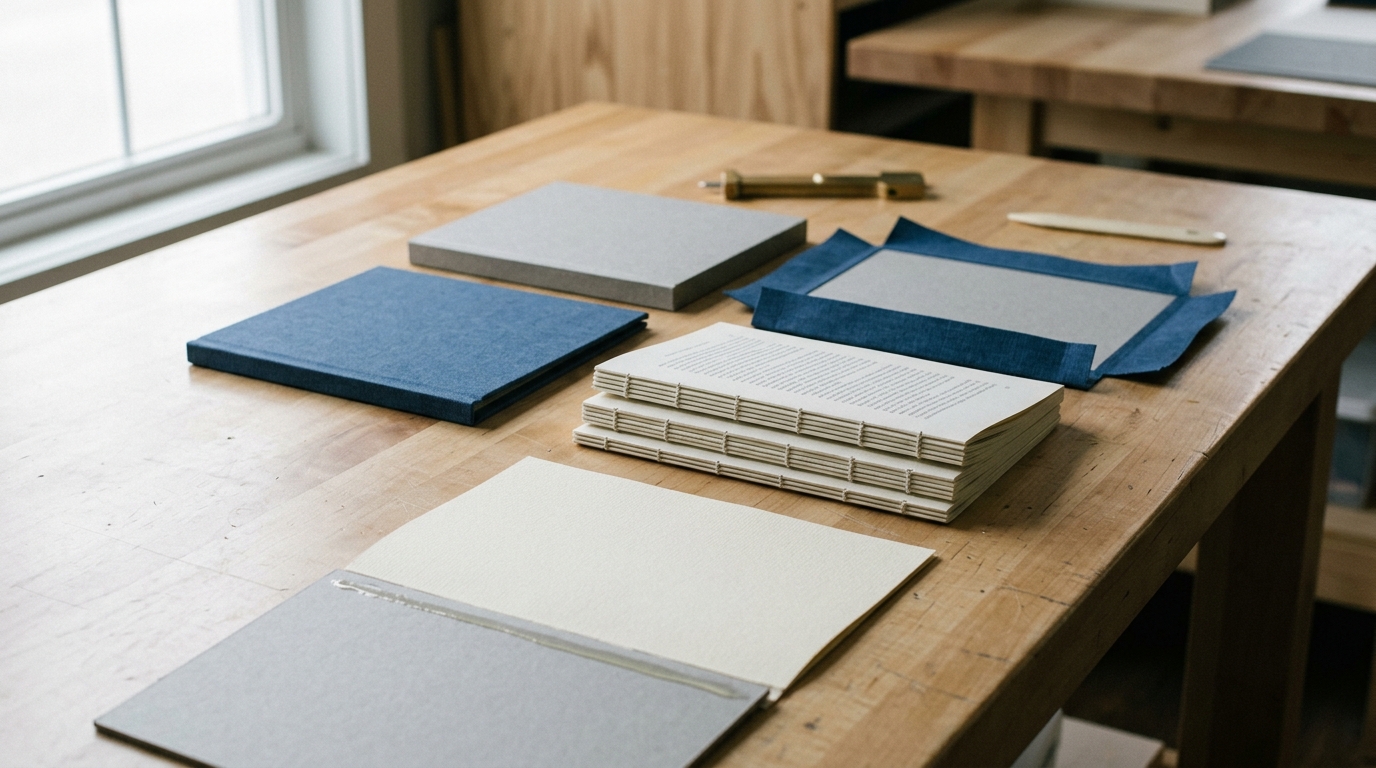
- Case assembly: Grey board, which is cardboard around 2mm to 3mm thick, gets wrapped in cloth, paper, or a material like Wibalin.
- Cover wrapping: The book block glues into the case. Endpapers then seal the two parts together.
Why Does Binding Choice Matter Most For First-Timers?
The binding really decides whether your book will survive being read over and over. Smyth-sewn holds up far better than glue on its own, which is called perfect binding, for any book over 200 pages. Manufacturers who make the cases in their own shop, such as LeadWorks, keep tight control over this stage, and that reduces spine cracking on thick titles.
Want to see how the finishing steps like foil and edge printing fit in? Read our guide to book finishing technology.
What Standard Hardcover Book Sizes Exist And How Do You Pick One?
The four most common hardcover trim sizes are 5.5×8.5 inches (novels), 6×9 inches (nonfiction and memoir), 8×8 inches (children’s and gift books), and 8.5×11 inches (cookbooks and reference). Pick the size your genre expects, because readers judge a book’s category by its shape before they read a word. Staying on standard sizes also keeps custom hardcover book printing affordable.
Which trim size fits which genre?
Match your dimensions to reader habits. A 6×9 memoir feels serious; the same story at 8×8 reads like a picture book. Here is how the four workhorse sizes line up:
| Trim Size (inches) | Best-Fit Genre | Why It Works |
|---|---|---|
| 5.5 x 8.5 | Fiction, poetry | Fits standard shelves and hands |
| 6 x 9 | Nonfiction, memoir, business | More words per page, lower page count |
| 8 x 8 | Children’s, gift, photo | Square frame flatters images |
| 8.5 x 11 | Cookbooks, textbooks, art | Room for full-bleed photos and recipes |
How do page count and paper weight change spine thickness?
Spine width depends on your total pages times paper caliper (thickness). A 300-page book on 80gsm text stock builds a roughly 0.75-inch spine; switch to heavier 120gsm coated paper for a photo book, and the same page count swells past 1 inch. Get the calculation wrong and your cover artwork shifts off the spine. Most printers, LeadWorks included, supply a spine formula once you confirm page count and stock.
Why do oversized trims cost more?
Non-standard sizes waste paper. Presses run fixed sheet dimensions, so an odd 9×12 trim may leave large offcuts, pushing material cost up. Hardcover and collector editions are a growing segment in 2026 print market commentary, but that premium comes from finishes, not risky dimensions. For photo-heavy projects, see the large-format full-color reference book example.
How Do You Set Up Print-Ready Files For A Hardcover Book?
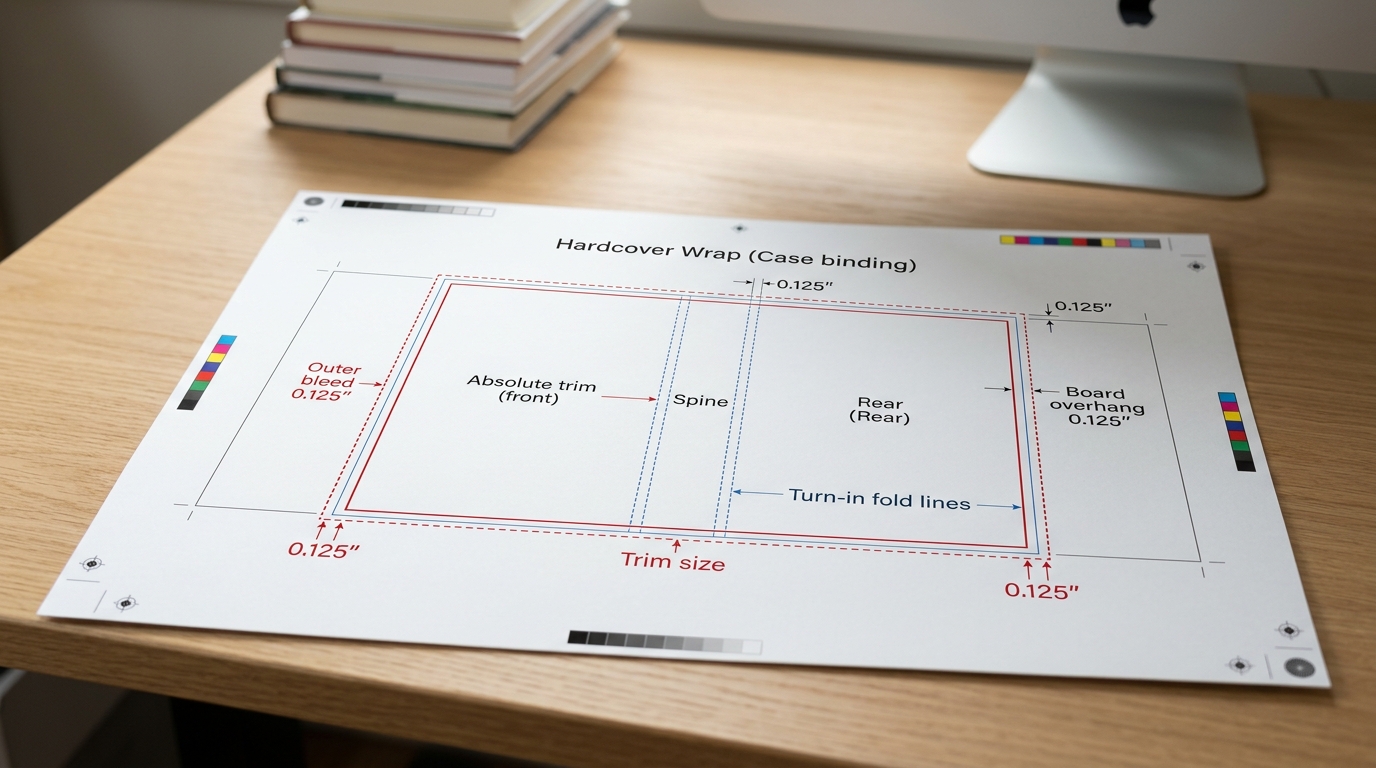
A print-ready hardcover file needs three things done right: 0.125-inch bleed on every outer edge, a spine width calculated from your exact page count and paper caliper, and CMYK color instead of RGB. Files reviewed across LeadWorks projects show wrong spine width and missing bleed cause most rejections, so lock those two first.
Bleed is the extra image area past the trim line. Printers cut through it, so color runs to the paper edge with no white slivers. Skip it and one crooked cut leaves an ugly white line. Keep live text and page numbers at least 0.375 inches inside the trim.
How Do You Calculate Spine Width?
Spine width equals page count times paper caliper, plus board thickness for hardcovers. Caliper is the thickness of one sheet in inches. A 300-page book on 80lb paper (caliper near 0.0043in) needs roughly a 0.65-inch spine before board. Get your exact caliper from the print supplier before building the cover wrap,guessing here misaligns your spine text.
What Goes Into The Full Cover Wrap?
The cover wrap is one flat sheet covering front, spine, and back, plus overhang. Hardcover boards stick out past the pages, so add board overhang (about 0.125in per edge) and turn-in (0.625in that folds around the board). Miss the turn-in and the wrap won’t fold cleanly.
- Front and back panels: trim size plus 0.125in board overhang on three sides
- Spine panel: calculated width, centered between panels
- Turn-in allowance: 0.625in on all four outer edges
- Bleed: 0.125in beyond the turn-in edge
Export as a flattened PDF/X-1a with fonts embedded and images at 300 DPI. Convert everything to CMYK using a profile like CMYK before export, since RGB colors shift on press. For finishing choices that affect your wrap layout, see the dust jacket vs slipcase guide.
How Much Does It Cost To Print A Custom Hardcover Book?
Custom Hardcover Book Printing generally runs $8 to $25 per copy when you order small quantities (25 to 100 copies), and it drops down to about $3 to $9 per copy at higher volumes (500 to 2,000 or more). The reason for this is fairly simple. The setup costs stay the same no matter how many books you print, so when you spread those fixed costs across more copies, the price for each individual book goes down. If you only print 25, you end up absorbing the full setup cost yourself. Print 1,000 and that same cost barely registers.
⚠️ Common mistake: Designing your cover and interior before choosing binding and paper. This happens because most people treat production specs as an afterthought, but those two choices lock in 60–70% of your per-unit cost—so redesigning around them later wastes hours. The fix: Pick your binding method (Smyth-sewn vs. glued) and paper GSM first, then design to those specs with 3mm bleed and 300 DPI.
What Actually Drives The Price?
There are five factors that affect your quote more than anything else. Here they are, ranked by how much they really cost:
- Menge: This is the single biggest lever you have. Setting up offset presses, which means making the plates and calibrating everything, can run $300–$800 before even one book comes off the press.
- Page count: More pages means more paper and thicker binding. A 300-page book costs more to bind than a 120-page one does.
- Paper: Standard 80–100 gsm text stock is the cheapest option; heavyweight art paper (150 gsm and up) adds roughly 20–40 cents per sheet.
- Binding: Sewn binding, where the folded sections are stitched together with thread, costs more than glued-only binding, but it holds up much better to repeated openings.
- Special finishes: Foil stamping, sprayed or printed edges, and embossing each add real money to the total. Sprayed edges alone can add $1–$3 per copy on short runs.
Demand for these premium touches is climbing. In 2026, 41% of book buyers prefer editions with unique printing techniques like letterpress or hand-binding, which pushes finish costs higher for collector runs.
A Concrete Budget Example
Say you want a 6×9-inch, 200-page hardcover with a full-color dust jacket and standard matte lamination. At 50 copies, you can expect roughly $14 to $18 each, so around $700 to $900 in total. At 1,000 copies, that same book drops to about $4.50 to $6 each, which comes to $4,500 to $6,000. The per-unit price fell by 65% even though the overall total went up.
LeadWorks handles edge printing and other special processes in-house, and this keeps those finish costs predictable instead of tacking on outsourced markups. If you plan to add dust jackets or slipcases, you should budget for those separately, since they’re add-ons and not part of the base book price.
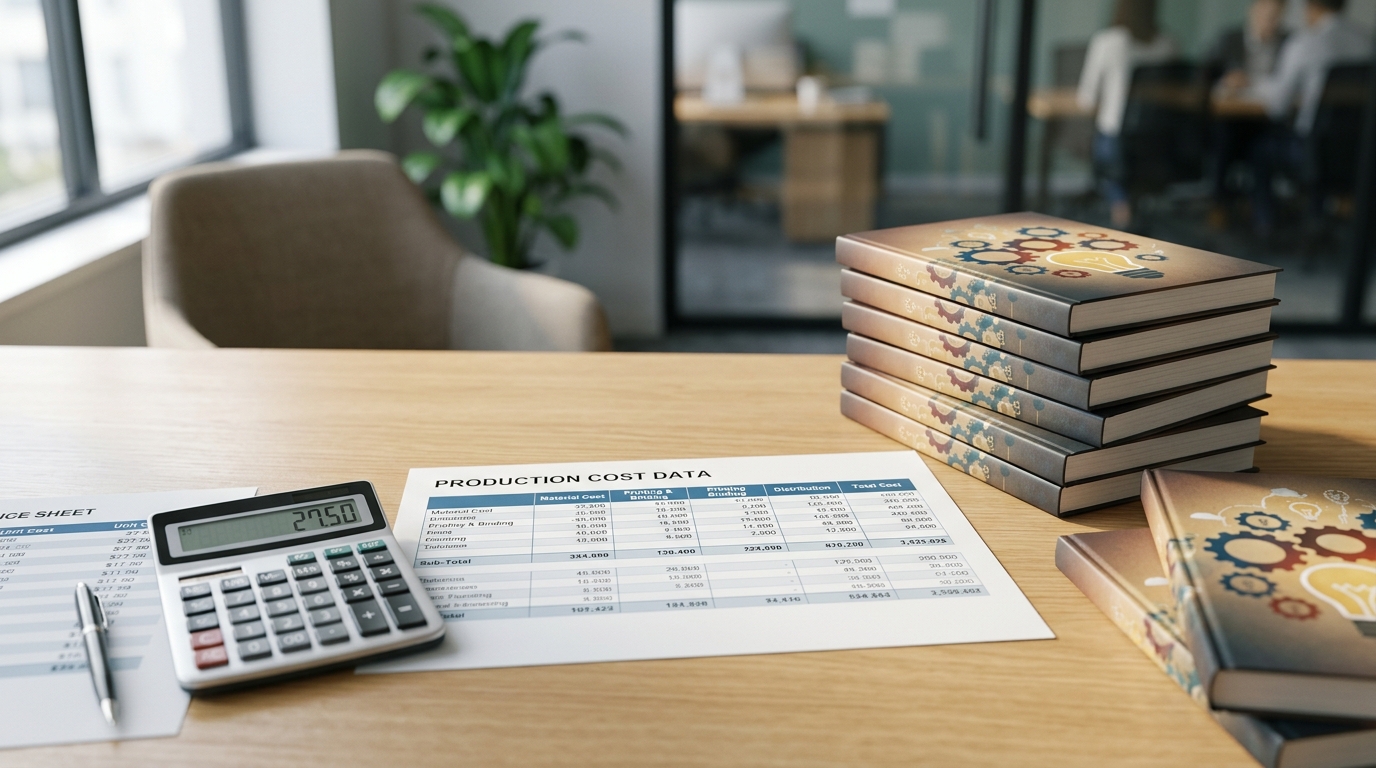
Print On Demand vs Bulk Offset Hardcover Printing — Where Is The Break-Even?
Offset printing usually beats print-on-demand (POD) once you order between 200 and 500 hardcover copies. Below that count, POD wins on cost and risk because you pay only for what sells. Above it, offset’s low per-unit price takes over. Your break-even depends on trim size, page count, and finishing choices.
Print-on-demand means the printer produces one book at a time, only after an order comes in. Offset means printing a large batch at once using metal plates. Digital printing and POD make short customized hardcover runs far cheaper than they were a decade ago,a shift that 2026 book printing trend reports flag as a key technology for self-publishers.
How Do Per-Unit Costs Compare At Different Quantities?
POD stays flat per copy,the tenth book costs the same as the first. Offset gets cheaper as volume climbs, because plate and setup fees spread across more units.
| Menge | POD per copy | Offset per copy |
|---|---|---|
| 50 copies | $14 | $28 |
| 250 copies | $14 | $13 |
| 1,000 copies | $14 | $7 |
What Trade-Offs Matter Beyond Price?
Price isn’t the whole story. Weigh these four factors before deciding:
- Inventory risk: Offset means paying upfront and storing boxes. Unsold stock ties up cash.
- Minimum order quantity (MOQ): Offset printers often set a 200-copy floor; POD has no minimum.
- Reprint speed: POD reprints in days; offset reorders take 2–4 weeks plus setup.
- Quality consistency: Offset holds tighter color and finish control across a full run—critical for edge printing or foil.
LeadWorks recommends offset for collector editions with special processes, where consistency across every copy matters most. For a first-run novel test, POD keeps risk near zero. Compare protection options in our dust jacket vs slipcase guide.
What Mistakes Do First-Time Hardcover Buyers Make Most Often?
The four costliest first-time errors in custom hardcover book printing are miscalculating spine width, over-ordering before demand exists, choosing glued binding for photo books, and skipping the physical proof. Each mistake commonly wastes $200 to $2,000, and all four are fully avoidable with one extra planning step before you hit “print.”
Why does spine width go wrong so often?
Spine width depends on page count and paper thickness (caliper), and guessing it wrong misaligns your title and shifts cover art onto the front board. A 300-page book on 80gsm paper needs a different spine than the same book on 120gsm stock. Get it wrong and the whole run reprints. Ask your printer for the exact spine measurement in millimeters after paper is locked,never estimate it yourself.
Why is over-ordering the most expensive gamble?
Ordering 1,000 copies before you know demand ties up cash in boxes you may never sell. With premium hardbacks increasingly produced as special and collector editions in 2026, unit costs are already high,so a failed 500-copy run at $12 each burns $6,000. Print a short validation batch of 50 to 100 first, sell those, then scale.
Which binding mistakes hurt photo books most?
- Glued (perfect) binding for photo books: pages won’t lie flat, splitting images across a spread. Use Smyth-sewn binding instead so spreads open fully.
- Skipping a physical proof: colors shift from screen to press. A single proof costs $30 to $80—cheap insurance against a $2,000 reprint.
LeadWorks recommends locking paper and binding style before finalizing files, since in-house process control catches spine and lay-flat errors before they reach the press. For image-heavy projects, review our binding and paper guide before ordering.
FAQ
Can you print just one hardcover copy?
Yes. Digital print-on-demand (POD) presses handle single hardcover copies with no minimum. This suits proofs, gifts, or family photo books. Expect to pay $30 to $60 for one copy because setup costs spread across a single unit instead of hundreds. By 2026, 62% of book printers offer on-demand customization for covers, which makes true one-off hardcover printing widely available.
What are typical minimum order quantities and turnaround?
Offset printers usually set a minimum order quantity (MOQ) of 250 to 500 copies. Turnaround runs 15 to 30 business days after file approval, plus shipping. POD ships in 5 to 10 business days but costs more per unit. Add a week if you request a physical proof, always do this for photo-heavy books to check color before the full run.
Do I need an ISBN and barcode?
You need an ISBN only if you plan to sell through retailers or libraries. The ISBN (International Standard Book Number) is a unique 13-digit product ID. In the US, buy them from Bowker. The barcode encodes that ISBN plus price. Private gift books skip both entirely.
What paper weight works for photo-heavy books?
- 150–170gsm gloss or matte art paper: standard for full-color photo pages; matte hides fingerprints.
- 200gsm+: for large-format art books where images bleed across spreads, preventing show-through.
LeadWorks recommends a printed proof on your chosen stock before committing, since gloss and matte shift color perception. See our guide on hardcover protection for finishing choices.
Choosing The Right Hardcover Printing Path For Your First Project
Match four variables in order,quantity, then printing method, then binding, then size,and your first hardcover project falls into place fast. Order under 250 copies? Choose digital print-on-demand. Order 300 or more? Offset saves real money per unit. This sequence prevents the budget guesswork that trips up most beginners.
Your quantity decision drives everything downstream. A short run of 50 novels works best as digital-printed, Smyth-sewn 5.5×8.5-inch books.
A 500-copy art book leans toward offset printing on a 8.5×11-inch trim with a printed cover laminate. The 2026 data showing 62% of printers now offer on-demand cover customization means small buyers get options that once required bulk orders.
Here is the roadmap in one glance:
| Your Goal | Menge | Method | Binding Choice |
|---|---|---|---|
| Author copies, gifts | 25–100 | Digital POD | Case bound, glued |
| Retail launch | 300–1,000 | Offset | Smyth-sewn |
| Collector edition | 200+ | Offset | Sewn + foil, sprayed edges |
Never skip the physical proof. Request a printed bound sample before approving a full run. Screen colors shift on paper, and a proof catches spine calculation errors that cost hundreds to reprint. LeadWorks recommends buyers review a hardbound proof for cover color, endpaper fit, and edge finish,especially on special processes like dust jacket versus slipcase protection,since 41% of buyers in 2026 favor unique printing techniques that demand tight quality control.
Your next step is simple. Send your final file specs, target quantity, and desired finishes to a printer, then ask for a written quote plus a physical proof. Compare two or three quotes on the same specs. That single proof turns custom hardcover book printing from a gamble into a controlled purchase.