Book Printing For Independent Authors Ready To Publish
Book Printing For Independent Authors splits into two paths: print-on-demand (POD), which produces one copy per order, and offset printing, which requires bulk stock for a lower per-unit cost. POD suits runs under 300 copies, while offset becomes cheaper past 500 units. Standard trade paperback trim is 6″ x 9″ for fiction, and print-ready files need 0.125″ bleed with 300 DPI images minimum. Services like B&N Press (2026) let authors avoid upfront batch costs by printing each copy as it sells.
LeadWorks suggests matching the method to your sales forecast before you ever look at a proof. This guide answers the questions that really shape your outcome, starting with one many authors ask first: how much does it actually cost to print a book?
And there’s the question of whether POD or offset suits the size of your run. You’ll also want to know what file settings and trim sizes printers ask for. Then comes the matter of how you set up a print-ready PDF and go about checking a proof. Finally, there’s the choice of which paper, which binding, and which cover finish you should pick.
Quick Takeaways
- Choose POD for runs under 300; offset saves money past 500 copies.
- Set trade paperback fiction at standard 6″ x 9″ trim size.
- Prepare files with 0.125″ bleed and minimum 300 DPI images.
- Always order a physical proof before approving your full print run.
- Calculate spine width using your page count and paper weight.
What Are Your Book Printing Options As An Independent Author?
Independent authors really have three printing paths to choose from: print-on-demand (which people call POD), short-run digital, and offset. POD prints a single copy at a time with no money needed up front. Short-run digital handles somewhere between 25 and 500 copies. Offset only starts making sense once you hit 500 or more copies. You should pick based on how many books you actually need and what your budget allows, not by whichever one sounds cheapest per single book.
Here is a quick way to figure out where you land. Are you ordering just for family, a few review copies, or a title that sells slowly from your backlist? Then POD is your answer. Are you launching at a live event, teaching a course, or selling books off a table somewhere?
Short-run digital gives you actual stock on hand without needing a warehouse to store it all. Do you have demand you have already proven and want the lowest possible price per unit? Offset wins that one, though only once you clear the minimum volume needed.
How many copies does each printing path require?
The minimum order essentially defines how much risk you take on. POD starts at just 1 copy, and Lulu states it supports single-copy orders and runs of 1,000 or more. Short-run digital usually starts somewhere around 25 copies. Offset needs 250 to 500 copies before the setup cost spreads out thin enough to actually beat digital pricing.
| Method | Minimum order | Best author profile |
| Print-on-demand | 1 copy | Testing a title, low or unknown demand |
| Short-run digital | 25 copies | Event sales, course books, small launches |
| Offset | 250–500 copies | Proven sellers, lowest unit cost |
Which method controls quality best?
Offset and short-run digital give you the tightest grip over color and the finishing touches, basically because you can inspect the whole batch and lock in one machine setting. POD trades away that control in exchange for zero inventory risk. You cannot inspect every single copy, and the color can shift between different print locations. That gap really matters most for full-color titles, special edges, or foil stamping, which usually need a dedicated printer to get right. LeadWorks handles book printing for independent authors at both short-run and offset volumes, with in-house edge printing and finishing work that most POD platforms simply cannot match. Save POD for text-heavy paperbacks where color accuracy is not the thing selling the book.
Short-Run Printing Vs Print-On-Demand — Which Is Better For Indie Authors?
Print-on-demand (POD) wins for authors selling under 300 copies a year; short-run printing wins once you sell more than that. POD prints one book per order at approximately $4.50,approximately $7 per paperback, so you never hold stock. Short-run printing at 300 copies drops your cost to roughly $2.80 per unit. The math flips near the 300-copy line.
What Do POD And Short-Run Actually Cost Per Copy?
POD charges a fixed per-book fee no matter how many you order. A 250-page black-and-white paperback usually lands between $4.50 and $7 through major POD networks. Short-run offset or digital runs spread setup costs across the batch, so the price per book falls as the quantity climbs, from about $3.90 at 100 copies to $2.80 at 300.
| Model | Menge | Cost Per Unit | Upfront Cash | Inventory Risk |
| Print-on-demand | 1 copy | $4.50–$7.00 | $0 | None |
| Short-run digital | 100 copies | $3.90 | ~$390 | Moderate |
| Short-run digital | 300 copies | $2.80 | ~$840 | High |
Where Do Authors Get The Break-Even Point Wrong?
Most authors calculate break-even on price alone and forget the money trapped in boxes. Yes, 300 copies at approximately $2.80 beats POD at approximately $6. But if you sell only 80 books in a year, the other 220 copies sit in your garage. That $616 of unsold stock earns nothing while POD would have cost you $0 upfront.
Beyond that dead cash, inventory loses money two more ways: storage space and edition mistakes. Spot a typo after a short run and you eat every unsold copy, while POD lets you fix the file and reprint the next order instantly. Short-run services often start at just 25 copies, which keeps the risk small for careful test batches.
Which Should You Choose As An Independent Author?
Pick POD for launch, unknown demand, and slow-moving genres like poetry or niche nonfiction. Pick short-run once orders are steady, or when you sell in person at events where the $2.80 unit cost widens your margin. Book printing for independent authors works best as a two-stage plan: validate with POD, then batch-print your proven seller.
Higher volumes unlock offset printing and special finishes that POD can’t touch. LeadWorks focuses on that mid-to-high-end tier, offset runs with in-house edge printing and foil work for authors ready to move past plain POD paperbacks. For a deeper look at how batch manufacturers price and produce, see how custom book manufacturers work. On the POD side, self-publishers can compare fulfillment options through platforms using print-on-demand technology.
Hardcover, Paperback, Or Full-Color — Which Format Should You Print?
Pick your format based on genre first and your budget second. Paperback works well for fiction and memoirs, hardcover fits gift books and literary titles, and full-color paper with a coated surface is a must for cookbooks and children’s books. Book printing for independent authors gets expensive quickly, considering that a case-bound hardcover costs roughly 2.5 to 3 times the per-copy price of a comparable paperback. That means the wrong choice eats into your profit before you ever sell a single book.
Case-Bound Vs Jacketed Hardcover — What’s The Difference?
Case-bound printing puts the cover art straight onto the hard cover itself, then seals it with a thin protective laminate film. A jacketed hardcover instead uses a plain cloth or printed board and then wraps a separate paper dust jacket around the outside. Those jackets cost an extra $1.50 to $3 per copy, though they let you reprint only the jacket if you adjust your pricing or add new endorsements later. For a first novel you can usually skip the jacket, and for children’s books it is better to go case-bound, since kids tend to peel and rip a jacket within a week.
Matte Or Gloss Lamination — Which Lasts Longer?
Neither finish really lasts dramatically longer than the other, though they wear out in different ways. Matte lamination hides fingerprints and small scuffs, which is why it is the usual pick for adult fiction and business books, but any scratches on it tend to show up as white lines. Gloss lamination makes photos look brighter and stands up to scratching better, so it is the winner for cookbooks and photography titles, even though it shows every single fingerprint. The price gap between the two is under 5 cents per copy, so you should choose based on how buyers will actually handle the book.
Why Do Cookbooks And Children’s Books Need Coated Stock?
Full-color images need coated paper because that coating keeps the ink sitting on the surface instead of letting it soak in. Uncoated paper absorbs the color and dulls it by 20% or more, which washes out your photos. Coated paper does add to the cost, and printing a full-color interior usually triples the price per page compared to plain black-and-white. Providers like Blurb offer coated options for exactly this reason.
LeadWorks suggests 128gsm to 157gsm coated art paper for full-color interiors, and it is worth doing a quick check for any color shift on skin tones before you commit to the full print run. That one small step keeps you from paying for costly reprints down the line.
| Format | Ideal für | Cost Vs Paperback |
| Paperback (perfect bound) | Fiction, memoir | Baseline (1x) |
| Case-bound hardcover | Children’s, gift books | 2.5–3x |
| Full-color coated | Cookbooks, photo books | 3x per page |
How Much Does It Cost To Print A Book And How Long Does It Take?
A standard 200-page paperback costs roughly $3.50,$6.00 per copy when you use print-on-demand (POD), which is the method where books get printed one at a time as orders come in. A 1,000-copy offset run, meaning a large batch printed all at once, drops the price down to $1.50,$3.00 per book.
⚠️ Common mistake: Ordering an offset run of 500+ copies to chase the lower per-unit price before you’ve validated demand. This happens because authors fixate on unit cost while ignoring that unsold inventory ties up cash and storage. The fix: match your print method to a realistic sales forecast—use POD for runs under 300 and reserve offset for past 500.
POD ships the fastest, and Lulu states its global network prints books in 3,5 business days.
Offset runs generally take 2,4 weeks to complete. Both the format you choose and the size of your run really shape these two numbers.
What are typical prices by run size and format?
The price per book drops sharply as the quantity goes up, because the fixed setup costs get spread across a much larger number of units. Short-run digital printing sits nicely between a single POD copy and a full offset run, and with some printers you can order proof batches starting at just 25 copies.
| Run size & format | Unit cost (200pp) | Turnaround |
| 25-copy proof, paperback | $5.00–$8.00 | 5–10 days |
| POD single paperback | $3.50–$6.00 | 3–5 days |
| 250-copy digital, paperback | $2.50–$4.00 | 7–14 days |
| 1,000-copy offset, paperback | $1.50–$3.00 | 2–4 weeks |
| 1,000-copy offset, hardcover | $4.00–$7.00 | 3–5 weeks |
What hidden fees inflate a printing quote?
The price you see up front rarely matches your final invoice. It’s worth keeping an eye on these line items:
- File setup / preflight fees: these run $25–$150 per title to check the bleed, the spine width, and the color profiles before anything gets printed.
- Shipping: POD adds $4–$8 for a single book, and bulk cartons cost more for each shipment you send out.
- Freight for hardcovers: 1,000 case-bound books weigh 400+ kg and often need pallet freight, which adds another $200–$600.
- Proof copies: a physical proof runs $10–$30 plus shipping, and if you skip it you run the risk of having to reprint the entire run.
When it comes to book printing for independent authors, LeadWorks recommends budgeting 15,20% above the quoted unit price so you can absorb the setup and freight charges. And it’s smart to order one proof before any run over 100 copies, because a $25 proof easily beats a $2,000 reprint.

How Do You Check A Proof Copy For Spine, Bleed, And Color-Shift Errors?
Order a physical proof, then inspect four things in order: spine text alignment, bleed cutoff, gutter loss, and CMYK color drift. Skip the digital-only proof. A printed copy catches errors a screen hides. For most print-on-demand orders you can get a single proof shipped in 3,5 business days, so budget one full week before approving a run.
How Do You Catch A Spine-Width Miscalculation?
Measure whether your spine text sits centered, not creeping onto the front or back cover. Spine width depends on page count and paper thickness (measured in points per inch, or PPI). A 200-page book on 55# paper runs about 0.5 inches wide. Guess wrong by even 1/16 inch and the title bleeds around the edge. Books under 80 pages often can’t hold spine text at all.
Where Do Bleed And Gutter Errors Hide?
Check that background images run fully to the trimmed edge with no white slivers. Bleed is the extra 0.125 inch of art that extends past the cut line, so trimming variance never leaves a white gap. Printers allow a cutting tolerance near 0.0625 inch, meaning the blade shifts slightly on every copy.
Gutter loss bites thick books hardest. The gutter is the inner margin swallowed by the binding. On a 400-page perfect-bound paperback, curved pages can hide up to 0.25 inch of inner text. Open your proof flat and confirm no words disappear into the spine.
How Do You Spot CMYK Color Drift?
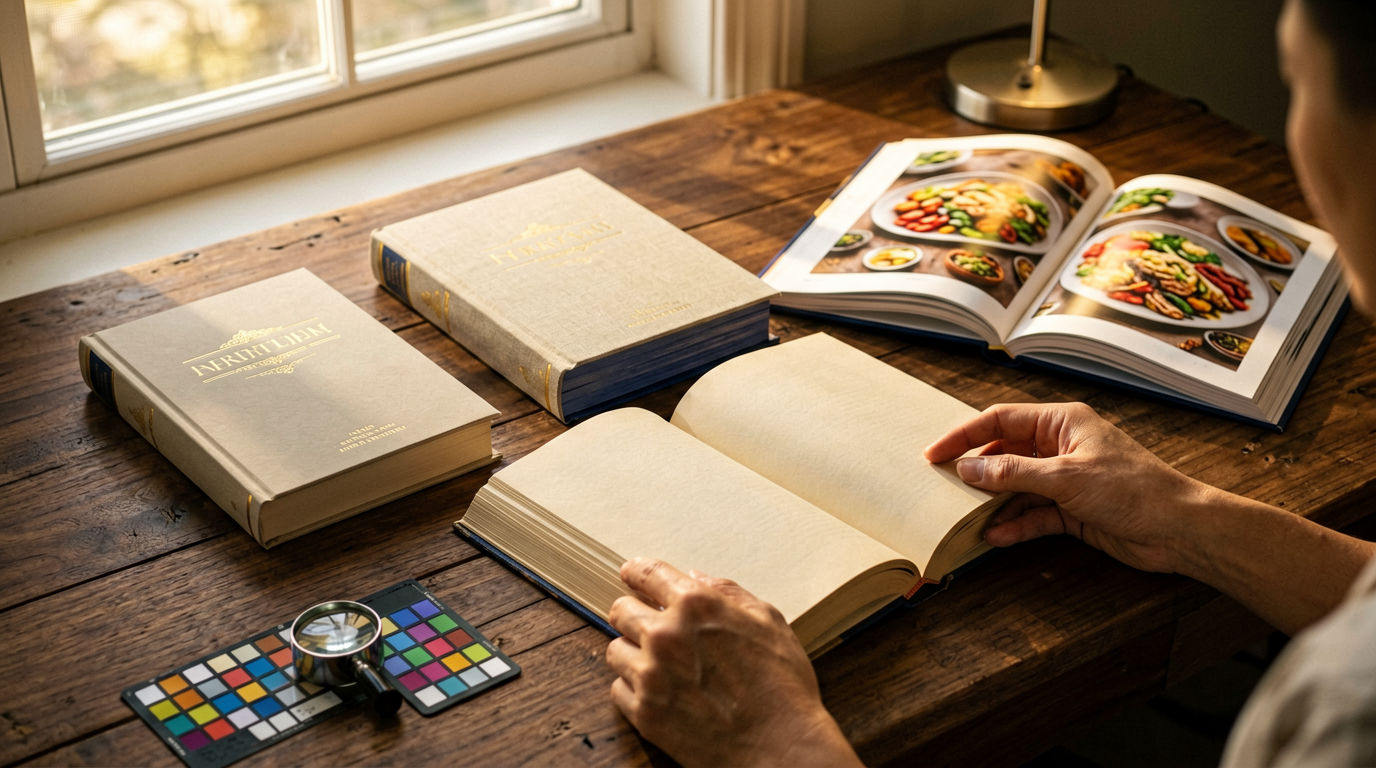
Compare your proof against a calibrated monitor and printed reference, since screens use RGB light while presses use CMYK ink. Bright blues and purples shift dullest, a vivid RGB blue often prints closer to navy. Request an ICC color profile from your book printing partner and soft-proof in the target color space before submitting. LeadWorks controls this drift in-house, which matters for full-color art books and photo interiors where a 10% ink shift ruins skin tones. For technical color rules, review the CMYK color model basics before your final approval.
How Do You Choose A Book Printing Partner That Supports Indie Authors?
Pick a printer that talks to you before the press runs, not after. The single biggest reprint trigger for indie authors is an online-only service with no proofing dialogue, you upload files, get a copy weeks later, and discover the spine text is off-center. A partner offering file-check support and a physical sample stops that loss before it costs you money.
Book printing for independent authors splits into two camps: in-house process control and brokered outsourcing. Knowing which one you’re buying changes everything about quality and accountability.
In-House Process Control Vs Brokered Outsourcing — What’s The Difference?
In-house means the printer owns the presses, binding line, and color calibration under one roof. Brokered outsourcing means your “printer” is a middleman who sends your file to whichever factory is cheapest that week. That matters because color and binding consistency depend on one team, one machine profile, one quality check. LeadWorks runs in-house process control for exactly this reason, including special processes like edge printing that brokers rarely handle without errors.
- In-house control: One accountable team; consistent color across reprints; direct fix if something’s wrong.
- Brokered outsourcing: Lower sticker price; unpredictable color match on reprints; support routes through a reseller.
Which Printer Type Actually Suits You?
Match the partner to your run size and quality needs. Global POD networks handle single copies and wide shipping, one such service prints in 3,5 business days and ships to 200+ countries (2026). Short-run specialists suit 25,500 copies. In-house manufacturers fit brand-quality or special-finish jobs.
| Printer type | Best for | Proofing dialogue |
| Global POD network | Single copies, wide distribution | Limited, file-upload only |
| Short-run specialist | 25–500 copies | Some file review |
| In-house manufacturer | Brand quality, special finishes | Full, sample-based |
Before you commit, confirm three things: does the printer offer a paid physical sample, do they run a pre-flight file check, and can you reorder with the same specs later? Skip any partner that answers “no” to reprint flexibility.
What Custom Layout And Special Finishes Are Worth Paying For?
Spend on custom interior layout first, foil stamping second, and edge printing only for special editions you can charge more for. For most independent authors, a professionally designed interior lifts perceived value more than any surface finish. Finishes shine when your reader already expects a premium object, think collector runs, gift books, or Kickstarter tiers.
Which finishes actually raise perceived value?
Custom interior layout is the safest money you’ll spend. Clean margins, real typesetting, and consistent chapter styling separate a self-published book from a printed manuscript. This matters most for cookbooks, poetry, and illustrated nonfiction where page rhythm carries the reading experience.
Heißfolienprägung and embossing pay off on hardcovers and dust jackets. A foil-stamped title (metallic ink pressed with heat) signals a gift-worthy object, which supports a higher shelf price. These processes are part of standard bookbinding finishing and add real production cost per unit.
When does edge printing burn budget instead?
Edge printing, decorated page edges, sometimes with sprayed color or printed art, is a vanity spend on a first print run. It lifts price only when buyers expect a collectible. On a debut paperback selling on Amazon, it adds cost without moving conversion.
Edge printing earns its keep in special-edition hardcover runs, where a $28 book can jump to $45+ retail. LeadWorks treats edge printing as a core in-house special process rather than an outsourced add-on, which keeps registration tight on collector runs. Book printing for independent authors works best when finishes match the sales channel, not the ego.
| Finish | Best for | Worth it on first run? |
| Custom interior layout | Cookbooks, poetry, nonfiction | Yes |
| Heißfolienprägung | Hardcover titles, gift books | Sometimes |
| Prägung | Covers, logos, series branding | Sometimes |
| Edge printing | Collector and special editions | No |
One rule: never add a finish you can’t recover in price. If your edition sells at the same number with or without it, it’s decoration you paid for.
Frequently Asked Questions About Printing Your Book
Here are direct answers to the questions indie authors ask most before sending files to press. Each covers a real decision point in book printing for independent authors, minimum orders, ISBNs, file specs, and rush timing.
What Is The Minimum Order Quantity For Printing A Book?
It depends on the method: print-on-demand (POD) prints a single copy on demand, while short-run offset presses set a floor. POD platforms confirm single-copy orders, one provider says it supports orders from one book up to quantities of 1,000+ (2026). For short-run projects, some printers start at 25 copies (an established self-publishing printer has run 25-copy minimums since 2001). LeadWorks handles both short runs and larger offset volumes when you want special finishes like edge printing.
Do You Need An ISBN Before Printing?
You don’t need an ISBN to print, but you need one to sell through bookstores and libraries. An ISBN (International Standard Book Number, a unique 13-digit ID for your title) links to a specific format, paperback, hardcover, and ebook each need a separate number. In the US, ISBNs come from Bowker, where a single ISBN runs about $125 and a block of 10 drops the per-unit cost sharply. Buy your own if you plan multiple titles; free platform-assigned ISBNs tie the number to that platform.
What File Format Does A Printer Require?
Two print-ready PDFs: one interior file and one cover file, exported with fonts embedded and images at 300 DPI. Most platforms accept exactly this, upload an interior PDF and a cover PDF to build the book. Set the cover as a single flat spread that includes front, spine, and back, sized to your final page count so the spine width is correct. Skip RGB color; convert to CMYK before export to avoid the color shift covered earlier.
How Fast Can A Rush Book Print Job Turn Around?
POD production runs 3,5 business days before shipping, per a major global print network (2026); shipping adds days on top. Offset short runs with special finishes take longer, plan two to three weeks. For a hard launch date, order proofs early and confirm the cutoff in writing before you pay.